
What are the best Shadeform alternatives for buying GPU time?
Shadeform alternatives compared: Nodus, SkyPilot, Vast.ai and Runpod, with H100 prices, recovery after a lost machine and a rework break-even rule.
Shadeform is good at one job: finding a GPU virtual machine across 30+ clouds and launching it from one account, so the right alternative depends on whether you also want someone to finish the run for you. Nodus takes the job itself, runs it on the cheapest capacity that will finish it, and restores its checkpoint if a machine is lost, at $2.60 per NVIDIA H100 SXM hour on the Nodus pricing page.
SkyPilot is the open-source choice for your own cloud accounts, Vast.ai has some of the lowest H100 sticker prices, and Runpod suits per-second container pods. We build Nodus, so read with that in mind. Every fact about another company links to its own docs or pricing page, and every sum is written out.
What does Shadeform actually do for you?
Section titled “What does Shadeform actually do for you?”Shadeform is a broker for VMs, not a job runner. Its docs describe a cloud GPU marketplace where you compare availability, price and specs across 30+ providers, then launch through one console, REST API, shade CLI or MCP server. Each instance is a plain VM you SSH into, with an optional startup script, container and persistent volume.
The pricing model is simple. Shadeform’s FAQ says it charges the same rate as going direct to the provider, with no extra fee, and passes your payment through. By default it launches into its own account with each provider (Shade Cloud), so you never sign up with them. You can also link your own provider account to spend existing credits or a negotiated rate.
The same FAQ is clear about the limits. Shadeform inherits each provider’s SLA, and its Docker launch option starts a container on your VM rather than running a serverless one. On spot instances, a reclaimed machine is terminated, and the guide asks you to checkpoint to a volume, make jobs resumable, and poll and relaunch yourself.
Which Shadeform alternative fits which buyer?
Section titled “Which Shadeform alternative fits which buyer?”Pick by who handles the run after launch. Shadeform and Vast.ai hand you a machine. SkyPilot and Nodus take a job and keep it going.
| Option | What you buy | Who restarts a lost run | H100 price signal | Good fit |
|---|---|---|---|---|
| Shadeform | VMs from 30+ clouds, one bill | You, from your own checkpoints | Single H100 listings $1.66 to $5.99, average $3.47 | Finding the cheapest live VM across clouds |
| Nodus | Jobs, Workspaces, Sandboxes, Functions | Nodus, from the last committed checkpoint | H100 SXM $2.60 | Runs that should finish without babysitting |
| SkyPilot | Open-source scheduler over your accounts | SkyPilot managed jobs | Whatever your clouds charge | Teams with several cloud accounts and credits |
| Vast.ai | Marketplace GPU instances | You | H100 SXM from $1.70, median $1.73 | Lowest sticker price, flexible hosts |
| Runpod | Per-second container pods | You | H100 SXM $4.39 Secure, from $2.69 Community | Containers on one provider |
Sources: Shadeform H100 directory and FAQ, Nodus pricing and attempts and recovery, SkyPilot managed jobs, Vast.ai pricing, Runpod pricing. Prices checked November 18, 2026.
One caveat on the Shadeform row. Its cheapest single-H100 listing is a PCIe VM, while the Nodus rate is for the H100 SXM, so the cards are close but not identical. Shadeform’s directory also changes as providers come and go, and its own cheapest-GPU guide shows that the lowest listed price is not always available.
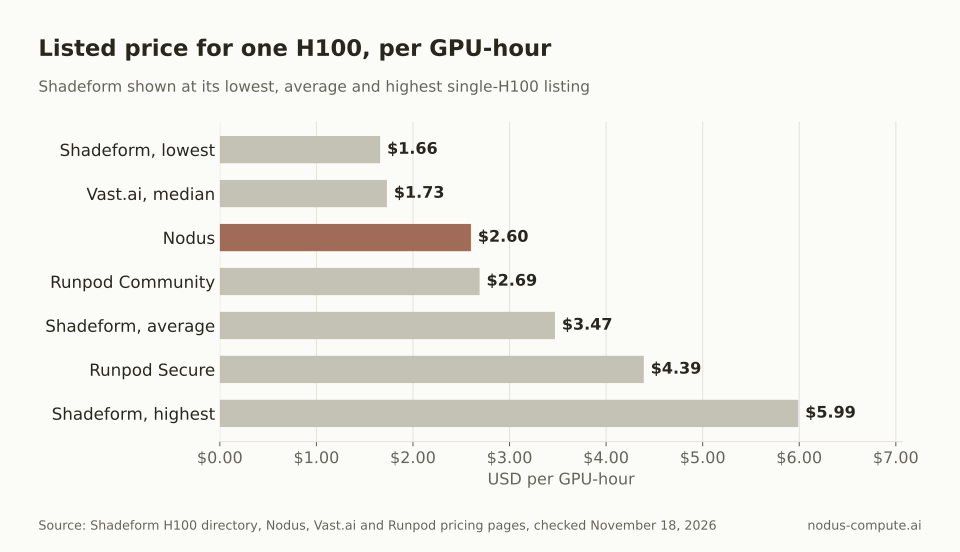 Shadeform’s spread is the story: its listings run from below Nodus to more than twice the Nodus rate.
Is Nodus cheaper than Shadeform for an 80-hour H100 run?
Section titled “Is Nodus cheaper than Shadeform for an 80-hour H100 run?”Nodus is cheaper than the average Shadeform H100 listing and dearer than the cheapest one. Take a fine-tune that needs one H100 for 80 hours, priced at each listed rate.
| Option | Rate per GPU-hour | 80 GPU-hours |
|---|---|---|
| Shadeform, lowest listing | $1.66 | $132.80 |
| Vast.ai H100 SXM median | $1.73 | $138.40 |
| Nodus H100 SXM | $2.60 | $208.00 |
| Runpod Community, from | $2.69 | $215.20 |
| Shadeform, average listing | $3.47 | $277.60 |
| Runpod Secure | $4.39 | $351.20 |
| Shadeform, highest listing | $5.99 | $479.20 |
Each row is the rate times 80: for example $2.60 x 80 = $208.00 and $3.47 x 80 = $277.60. Against the average Shadeform listing, Nodus saves $69.60 on this run. Against the cheapest listing, Nodus costs $75.20 more, if that listing is live when you need it and the run never loses its machine.
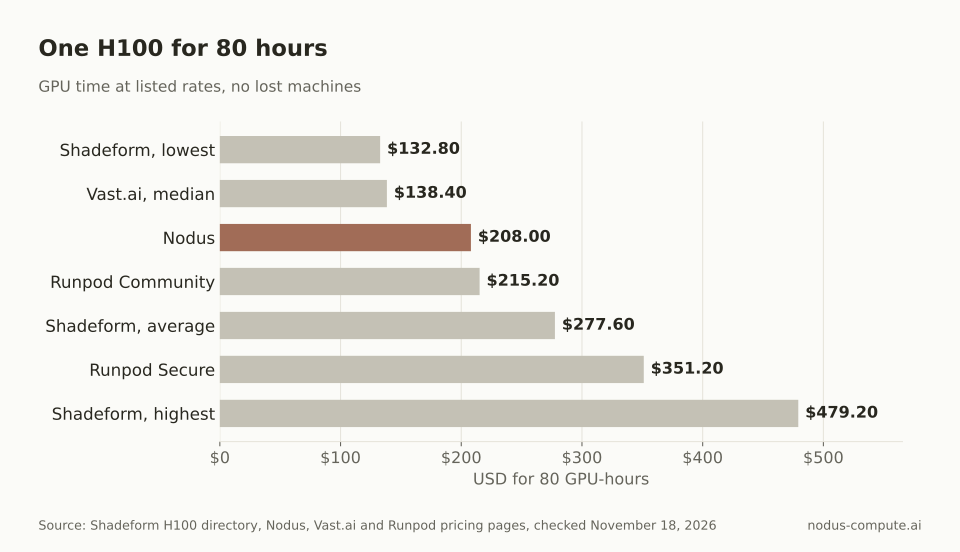 At list prices the cheapest VM wins a clean run; the average Shadeform listing costs 33% more than Nodus.
How much rework can a cheaper listing absorb before Nodus wins?
Section titled “How much rework can a cheaper listing absorb before Nodus wins?”The cheapest rate only stays cheapest while the run goes cleanly. When a VM is lost and your scripts restart from scratch, you pay again for the hours you redo. That gives a simple break-even rule we use when pricing runs:
A listing at price p beats Nodus only if p x (1 + r) is below $2.60, where r is the share of the run you expect to redo.
Solving for r gives the rework each Shadeform price tier can absorb. These assume the Nodus run redoes nothing, which is close to true for a checkpointed Job that loses only the minutes since its last checkpoint.
- $1.66 listing: 2.60 / 1.66 = 1.566, so it stays cheaper until you redo 56.6% of the run.
- $1.99 listing: 2.60 / 1.99 = 1.307, so the limit is 30.7%.
- $2.48 listing: 2.60 / 2.48 = 1.048, so the limit is 4.8%.
- $2.50 listing: 2.60 / 2.50 = 1.040, so the limit is 4.0%.
On the 80-hour run, 4.0% is 3.2 hours. Losing one machine late in the run without a good resume path wipes out the saving from a $2.50 listing. The $1.66 listing has far more room, which is why it is a fair pick for short, restartable work.
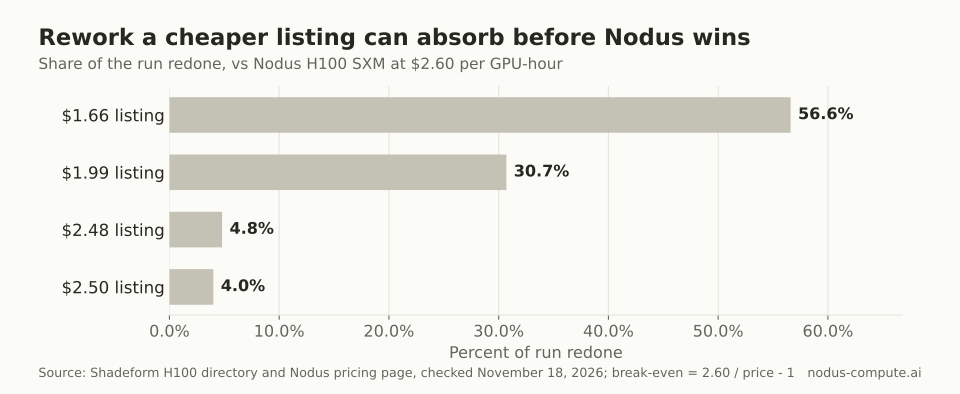 Below about $2 a GPU-hour, a listing can survive real rework; near $2.50, one bad restart erases the gap.
What happens on Nodus when a machine is lost mid-run?
Section titled “What happens on Nodus when a machine is lost mid-run?”Nodus starts a new attempt somewhere else and restores your files. Its attempts and recovery page describes the sequence. On a reclaim notice, Nodus asks your program for an urgent checkpoint while it prepares a replacement, which starts only once the old machine is provably gone. A machine that stops sending heartbeats gets a replacement prepared after 20 seconds and is declared lost after 60 seconds on shared capacity.
The contract is files, not memory. Your program writes weights, optimizer state and its step counter to /nodus/state, and the checkpoint guide shows the Job spec defaults:
recovery: continuity: Checkpointed # restore the latest checkpoint into each new attempt checkpoint: paths: [/nodus/state] # up to 64 absolute paths, all saved in one checkpointThat is the work Shadeform’s spot guide leaves to you: the polling, the relaunch and the restore. For a wider view of the same pattern across providers, see how GPU capacity failover works.
Where is Shadeform the better choice?
Section titled “Where is Shadeform the better choice?”Shadeform is the better choice when you want a VM, not a managed run. If your team lives in SSH, tmux and its own scripts, a plain machine with no new job format is the shortest path. Shadeform gets you one from many providers without opening many accounts.
It also wins on price discovery. One API call sorted by price across 30+ clouds is hard to beat for finding the cheapest live H100, and its lowest listing in this check, $1.66, is below the Nodus rate. Short jobs that restart cleanly can bank that difference.
Three more cases favour it. You can link your own provider accounts and launch into them to spend existing credits. Shadeform offers reserved contracts, with a 12-month minimum term on its pricing page. And if you already use SkyPilot, Shadeform has a SkyPilot guide that adds its catalog as one more cloud.
Are SkyPilot, Vast.ai and Runpod better fits for some teams?
Section titled “Are SkyPilot, Vast.ai and Runpod better fits for some teams?”Yes, each one fits a narrower buyer than Shadeform or Nodus.
SkyPilot is the closest to Nodus in spirit. It is open source under Apache 2.0 and runs jobs on Kubernetes, Slurm, reserved GPUs or 20+ clouds that you hold accounts with. Its managed jobs recover from preemptions, node crashes and GPU errors, and your job can reload its latest checkpoint. You run the software and keep the provider bills.
Vast.ai is the sticker-price option. Its pricing page lists the H100 SXM from $1.70 per hour, with a 30-day median of $1.73. Like a Shadeform VM, you handle restarts yourself. Our Vast.ai alternatives post goes deeper.
Runpod fits teams that want per-second container pods on one provider. Its pricing page lists the H100 SXM at $4.39 per hour on Secure Cloud and from $2.69 on Community Cloud. See our Runpod alternatives guide for the trade-offs.
Can you connect a Shadeform account to Nodus?
Section titled “Can you connect a Shadeform account to Nodus?”No. Nodus’s cloud accounts docs list AWS, GCP, Azure and a set of API-key clouds such as Lambda, Nebius and Runpod, and Shadeform is not among them. If you hold credits with one of the listed clouds, you can connect that account directly and have Nodus spend those credits before Nodus capacity (Beta).
How do you move a Shadeform workflow to Nodus?
Section titled “How do you move a Shadeform workflow to Nodus?”Keep your training script and point its saves at /nodus/state. Then submit it as a Job from the project directory, with a dry run first. The commands come from the install and quickstart pages:
pip install nodus-computenodus loginnodus run --name finetune --gpu H100 --image nodus/pytorch \ --max-cost 25 --timeout 8h --dry-run -- python train.pyThe dry run uploads the directory and shows the estimate without starting anything. Remove --dry-run to submit. --max-cost sets a hard dollar limit for the Job, and nodus describe job/finetune shows its attempts, placement and cost. Your SSH key, startup script and polling loop go away; the state directory replaces them.
If you want to compare GPU types before committing, a Sweep runs the same Job across several GPUs and reports the cheapest and fastest cell. Our post on running one training job across several GPU clouds covers the wider design.
Does Shadeform have more GPUs than going to a provider directly?
Section titled “Does Shadeform have more GPUs than going to a provider directly?”No. Its FAQ says it taps each provider’s on-demand pool, so what you see on Shadeform is what you would see at the provider. What it adds is one search, one account and one bill across them.
Does Nodus work the same way as Shadeform?
Section titled “Does Nodus work the same way as Shadeform?”No. Shadeform lists VMs for you to launch and manage, while Nodus runs the work itself. You submit a Job, Function or TrainingJob, Nodus picks the capacity, and recovery and billing are per run.
Do Shadeform spot instances resume automatically?
Section titled “Do Shadeform spot instances resume automatically?”No. Its spot guide says a reclaimed instance is terminated and marked preempted, and billing stops. Restarting it, on spot or on-demand, is up to your own polling and relaunch code.
Can an AI agent buy GPU time through Shadeform or Nodus?
Section titled “Can an AI agent buy GPU time through Shadeform or Nodus?”Both have a hosted MCP server. Shadeform’s lets Claude Code, Cursor or Codex find and manage instances. The Nodus server creates resources only after an accepted dry run and runs under the person’s own projects and spending limits.
Which data centers do Shadeform GPUs run in?
Section titled “Which data centers do Shadeform GPUs run in?”Shadeform’s FAQ says it guarantees all GPUs are in Tier 3 or Tier 4 data centers. Machine SLAs are the underlying provider’s, which Shadeform shares on request.
More from the blog
api8 min read
How do you host your own LLM behind an OpenAI-style API?
Run vLLM's OpenAI-compatible server on a GPU that fits the model, lock it down, and change one base_url. Commands, GPU costs and a decision rule.
Read the postevaluation6 min read
How do you evaluate citations in RAG answers?
A working citation can point to an on-topic page that does not support the claim. Score support, claim coverage, and answer completeness separately.
Read the post