
Nodus vs SkyPilot: which runs training across clouds better?
Nodus vs SkyPilot for training across clouds: who runs the control plane, the same job in each, preemption recovery, real costs, and when SkyPilot wins.
Pick SkyPilot if you want free, open-source software that you run yourself across your own cloud accounts, Kubernetes and Slurm clusters, with full control of every machine. Pick Nodus if you would rather not operate that layer: it places each training job on the cheapest capacity that will finish it, in cloud accounts you connect or on Nodus capacity listed at $2.600 per H100-hour. When a machine is about to be reclaimed, Nodus asks your program for a checkpoint and restores the run elsewhere.
We build Nodus. Every SkyPilot fact below links to SkyPilot’s own docs, GitHub or website, and one section covers where SkyPilot is the better choice.
How do SkyPilot and Nodus compare at a glance?
Section titled “How do SkyPilot and Nodus compare at a glance?”The real choice is who owns the control plane. SkyPilot is an orchestrator you install; Nodus is a managed platform you send jobs to.
| SkyPilot (open source) | Nodus | |
|---|---|---|
| What it is | Software that combines your clusters, clouds and machines into one compute pool | A managed AI compute platform that runs Jobs and TrainingJobs to completion |
| Price of the software | Free, Apache-2.0 license | No software fee; listed compute rates, or a $0.02 per device-hour route fee in your own account |
| Where jobs run | Your own accounts: Kubernetes, Slurm, AWS, GCP, Azure and 20+ other clouds, plus existing machines | Nodus capacity, or your connected AWS, GCP, Azure, Kubernetes and API-key accounts (Beta) |
| Control plane | An API server you run locally or deploy for your team | Run by Nodus |
| Failover | Retries other regions or clouds in the search space you define | Next cheapest offering that fits your request, deadline and budget |
| Recovery after preemption | Managed jobs relaunch on new resources; restart from scratch unless your code checkpoints | New attempt restores the last committed checkpoint; urgent checkpoint requested on a reclaim notice |
| Multi-node in your own accounts | Yes, with --num-nodes |
No; multi-node runs use Nodus capacity |
| Spend controls | Your cloud’s billing and budgets | Per-job --max-cost cap, per-account credit limits |
| Coding agents | Official agent skill for Claude Code and Codex | Hosted MCP server for Claude Code, Codex and Cursor |
Sources: SkyPilot overview, SkyPilot GitHub README and license, skypilot.ai, managed jobs, auto-failover, API server, agent skills; Nodus cloud accounts, placement, attempts and recovery, nodus run, connect an agent. Checked November 28, 2026.
What does the same training run look like in each?
Section titled “What does the same training run look like in each?”Both describe the job by the hardware it needs, not by a cloud. Here is one 8 x NVIDIA H100 fine-tune on interruptible capacity that saves checkpoints, written for each tool.
The SkyPilot version is a task YAML built only from keys shown in the managed jobs docs: accelerators, use_spot, job_recovery, a bucket file_mounts entry for checkpoints, and run:
name: qwen-finetuneresources: accelerators: H100:8 use_spot: true job_recovery: max_restarts_on_errors: 3file_mounts: /checkpoint: name: my-checkpoint-bucket mode: MOUNT_CACHEDworkdir: .run: | torchrun --nproc_per_node=8 train.py --checkpoint-dir /checkpointsky jobs launch -n qwen-finetune train.yamlThe Nodus version is one command. Every flag comes from the nodus run reference, where --interruptible with no value means prefer interruptible capacity and --checkpoint defaults to /nodus/state:
nodus run --name qwen-finetune --gpu H100:8 --interruptible \ --checkpoint /nodus/state --max-cost 220 -d -- torchrun train.pyTwo differences matter in practice. With SkyPilot you name and own the checkpoint bucket; on Nodus your script writes to /nodus/state (also in NODUS_STATE_DIR) and Nodus stores and restores it, per the checkpoints guide. And the Nodus command carries a hard spend cap: at the listed $2.600/hr, 80 GPU-hours is 80 x $2.600 = $208.00, so a $220 cap covers the run with a little headroom.
Who picks the cloud, and what happens when one runs out?
Section titled “Who picks the cloud, and what happens when one runs out?”Both tools fall back automatically when the first choice has no capacity. They differ in who defines the choices.
SkyPilot’s auto-failover retries other regions or clouds when a launch fails for lack of capacity or quota. You set the search space with resources.infra, from one zone to anything, and SkyPilot picks the cheapest available option within it for elastic VMs, according to its overview. The clouds in that space are the ones you have set up credentials for, which sky check verifies.
Nodus places each run on the cheapest offering that fits the request, has a machine free and stays inside your limits, per the placement docs. Offerings that would miss your deadline or exceed your remaining budget are dropped before anything is picked.
If you connect cloud accounts, Nodus spends them first in the order you set with --priority. The --burst setting decides whether a job overflows to Nodus capacity, waits for your approval, or waits for your account. nodus describe lists the chosen offering, the fallbacks and every rejected one with its reason.
Our rule: if you already hold credits in several accounts and have someone who enjoys owning infrastructure, SkyPilot’s search space is a clean model. If you want overflow capacity to exist without opening another account, that is what Nodus adds.
What happens when a spot machine is reclaimed mid-run?
Section titled “What happens when a spot machine is reclaimed mid-run?”Both relaunch the job automatically; neither can save work your program never wrote down. The difference is how much help the program gets at the moment of the reclaim.
SkyPilot managed jobs recover from preemptions, node crashes and GPU errors by provisioning a new temporary cluster. The docs say plainly that by default a job restarts from scratch after each recovery, and recommend periodic checkpoints to a Kubernetes volume or cloud bucket. User code failures are not retried unless you set max_restarts_on_errors.
On Nodus, a Checkpointed run starts each new attempt from its last committed checkpoint. When capacity gives notice that it is about to be reclaimed, Nodus asks your program for an urgent checkpoint and prepares the replacement machine at the same time. A checkpoint committed during that notice still counts, per attempts and recovery. A machine that stops sending heartbeats gets a replacement prepared after 20 seconds.
To see why the checkpoint strategy matters more than the tool, take the 8 x H100 run from above and suppose the machine is reclaimed at hour 7. This is arithmetic on a scenario, not a measurement:
| Checkpoint strategy | Work redone |
|---|---|
| No checkpoints, restart from scratch | 7 h x 8 GPUs = 56 GPU-hours |
| Periodic checkpoint every 30 minutes | Up to 0.5 h x 8 GPUs = 4 GPU-hours |
| Checkpoint saved during the reclaim notice | About 0, if the save finishes in time |
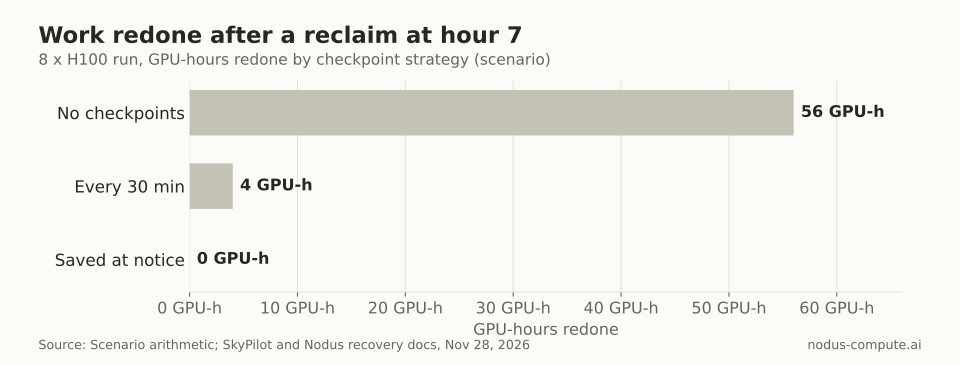 You can reach the first two rows with either tool; the third needs something to ask your program to save at the notice.
At the Nodus H100 rate, 56 redone GPU-hours is 56 x $2.600 = $145.60. We go deeper on the resume side in how to resume training after spot preemption.
What does each cost beyond the GPUs?
Section titled “What does each cost beyond the GPUs?”SkyPilot’s software costs $0.00, and Nodus adds a small fee in your own account; the larger cost of SkyPilot is the time you spend running it.
In your own cloud account, both leave the machine bill with your cloud. For an own-account GPU Job, Nodus shows a route fee of $0.02 per device-hour, per the cloud accounts guide. For the 80 GPU-hour run, that is 80 x $0.02 = $1.60.
SkyPilot is free under Apache 2.0, but managed jobs need something to watch them. With a local API server, SkyPilot launches a small jobs controller VM in your cloud, which its docs put at about $0.25/hour while running and under $0.004/hour when stopped, autostopping after 10 idle minutes. Over the 10-hour run, that is roughly 10 x $0.25 = $2.50 on your cloud bill. A team that deploys a remote API server instead pays for wherever it runs that server.
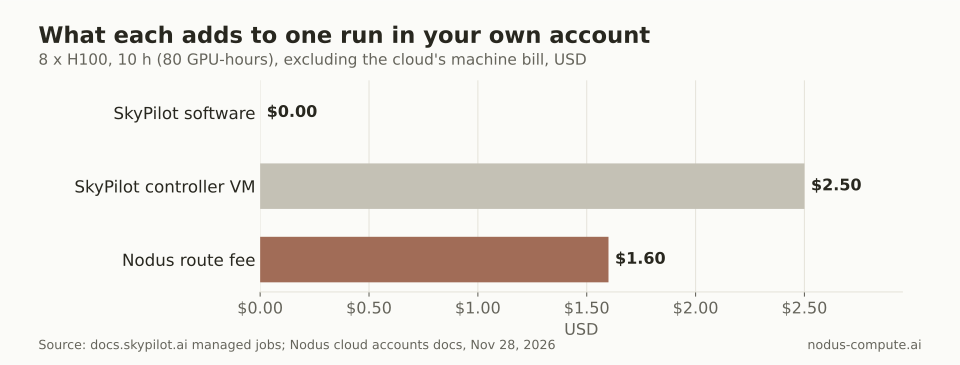 In your own account, the dollar difference is noise; the real difference is who operates the control plane.
The cost that does not appear on any invoice is operating time: deploying and upgrading the API server, keeping cloud credentials and quotas current, and debugging failed launches. We have no public number for it, so use your own: hours per month times your team’s hourly cost. If that is more than a rounding error, a managed platform is cheaper even when the software is free.
When your accounts are full or you have none, Nodus can run the job on its own capacity. The H100 SXM 80 GB is listed at $2.600/hr on the Nodus pricing page, so the run costs $208.00 all in. SkyPilot has no capacity of its own to fall back to, which is by design: it only uses infrastructure you bring.
Where is SkyPilot the better choice?
Section titled “Where is SkyPilot the better choice?”SkyPilot is the better pick in several real situations, and we would recommend it in each.
- You want open-source software you can read, fork and run with no vendor in the path. SkyPilot is Apache-2.0 on GitHub with a public Slack community.
- You need breadth. Its README lists Kubernetes, Slurm, AWS, GCP, Azure, OCI, CoreWeave, Nebius, Lambda Cloud, RunPod and many more, plus on-prem machines. Nodus connects fewer account types.
- Everything must stay inside your accounts. With SkyPilot, jobs, logs and the controller all live in infrastructure you own.
- You run multi-node training on your own reserved capacity. SkyPilot launches multi-node clusters in your accounts; Nodus runs multi-node jobs, a Beta capped at 8 nodes per the multi-node guide, only on Nodus capacity.
- You have a large Slurm or Kubernetes fleet shared by many researchers. SkyPilot adds queueing, multi-tenancy and a dashboard on top, and the company also sells a fully managed SkyPilot Platform for teams that want that without running it.
Can you use both, and how do you move a job to Nodus?
Section titled “Can you use both, and how do you move a job to Nodus?”Yes. Nothing stops you from keeping SkyPilot for multi-node work in your reserved clusters and sending single-node fine-tunes and sweeps to Nodus.
Moving one job is mostly deleting YAML. Keep train.py, change its checkpoint directory from /checkpoint to NODUS_STATE_DIR, and launch it with the nodus run command shown earlier. If your credits live in AWS, connect the account once so the same job runs there first. This command is copied from the cloud accounts guide:
nodus cloud connect aws aws-main --credit-limit 500For the broader picture of spreading training over several providers, including credit order and burst rules, see how to run training jobs across multiple GPU clouds. If you are weighing whether you need a cluster at all, read do you need Kubernetes for GPU training.
Is SkyPilot really free?
Section titled “Is SkyPilot really free?”The open-source software is free under the Apache-2.0 license. You still pay your clouds for machines, storage and any jobs controller or API server you run. We found no published prices for the separate, fully managed SkyPilot Platform.
Does Nodus run work inside my own Kubernetes cluster?
Section titled “Does Nodus run work inside my own Kubernetes cluster?”Yes, as a Beta. Nodus runs pods in one namespace you grant it, asks for whole GPUs on the nodes you pick, and meters your credit limit at the hourly rate per GPU you enter. If no node has room, it waits up to 10 minutes for your autoscaler before running the work elsewhere.
Can a SkyPilot managed job recover from my own code crashing?
Section titled “Can a SkyPilot managed job recover from my own code crashing?”Only if you ask. Hardware failures and preemptions are recovered by default, while non-zero exit codes need max_restarts_on_errors or recover_on_exit_codes in job_recovery. On Nodus, failures caused by your command, such as out of memory, fail fast and are not retried.
Can an AI coding agent launch jobs on either?
Section titled “Can an AI coding agent launch jobs on either?”Yes. SkyPilot ships an agent skill installable as a Claude Code plugin. Nodus runs a hosted MCP server that agents use with your account, projects and spending limits, and creating resources through it requires an accepted dry run first.
More from the blog
benchmark9 min read
How do you train a Flux or SDXL LoRA on a cloud GPU?
Run diffusers' DreamBooth LoRA script as one GPU job: SDXL fits a 24 GB card, Flux dev needs 26 GB in BF16 or 9 GB with QLoRA. Recipe, VRAM and cost.
Read the postkubernetes8 min read
Do you need Kubernetes to run GPU training jobs?
Most teams don't. Kubernetes earns its cost for GPU training when a platform team, shared inference or many teams already exist. Decision rule and cost math.
Read the post