
Is the NVIDIA H100 outdated now that Blackwell is here?
The H100 is no longer NVIDIA's fastest GPU, but it is not outdated. Blackwell must run 2.115x faster to cost less per run on Nodus. A decision rule.
The NVIDIA H100 is no longer the fastest GPU NVIDIA sells, but it is not outdated: it is fully supported by current CUDA, widely available, and for jobs that fit in 80 GB it often still costs the least per finished run. On Nodus the H100 SXM is listed at $2.60/hr and the B200 at $5.50/hr, so a B200 has to finish your job 2.115 times faster to cost less, and published training benchmarks land just under that. Blackwell wins when its memory removes a second node, when a tuned serving stack pushes token throughput past that ratio, or when finishing sooner is worth a few percent more.
That makes “outdated” the wrong frame. A GPU becomes outdated when software stops supporting it or when a newer part does the same work for less money. Neither has happened to the H100 yet, so the useful question is which of your jobs still belong on it.
What would make a GPU outdated?
Section titled “What would make a GPU outdated?”Three things, and only one of them is speed. Software support decides whether your stack still runs. Availability decides whether you can get the capacity. Value decides whether the job costs more than it would on a newer part.
The H100 passes all three for a large share of real workloads, though it now loses the third test for some of them.
Does NVIDIA still support the H100 in its software?
Section titled “Does NVIDIA still support the H100 in its software?”Yes, and it is far from the cutoff. The CUDA Toolkit release notes show CUDA 13.0 removing support for Maxwell, Pascal and Volta, the generations before Turing. Hopper, the H100’s architecture, sits two data center generations after Volta. The same notes still list new work for it: cuBLAS in CUDA 13.5 improved low-alignment BF16 matmuls “on Hopper and newer GPUs”.
What has changed is where NVIDIA puts its attention. The NVIDIA HGX page now lists Vera Rubin, HGX B300 and HGX B200, with B300 and B200 marked as shipping now. Its spec tables do not include an H100 system.
New features, such as FP4 Tensor Cores, arrive on Blackwell first. The H100 page lists FP8 and INT8 as its lowest Tensor Core precisions, with no FP4.
Is the H100 still good value per dollar?
Section titled “Is the H100 still good value per dollar?”For dense BF16 math it is close to Blackwell and ahead of the B300. We divided NVIDIA’s peak dense figures by the hourly rate each GPU is listed at on the Nodus pricing page.
| Per GPU | H100 SXM | B200 | B300 |
|---|---|---|---|
| Listed on the Nodus pricing page | $2.60/hr | $5.50/hr | $6.943/hr |
| Memory (Nodus pricing page) | 80 GB | 180 GB | 288 GB |
| Dense BF16 Tensor Core | 989.5 TFLOPS | 2,250 TFLOPS | 2,250 TFLOPS |
| Dense BF16 TFLOPS per $1/hr | 380.6 | 409.1 | 324.1 |
| Memory GB per $1/hr | 30.8 | 32.7 | 41.5 |
| FP64 Tensor Core | 67 TFLOPS | 37 TFLOPS | 1.25 TFLOPS |
| Price ratio to H100 | 1.000x | 2.115x | 2.670x |
H100 figures come from NVIDIA’s H100 page, which lists 1,979 TFLOPS of BF16 with sparsity; we halved it. B200 and B300 figures come from the HGX page, which lists 8-GPU systems: 36 PFLOPS BF16 with sparsity for both, and 296 TFLOPS (B200) and 10 TFLOPS (B300) of FP64. We halved the sparse figures and divided by 8. Prices checked November 28, 2026.
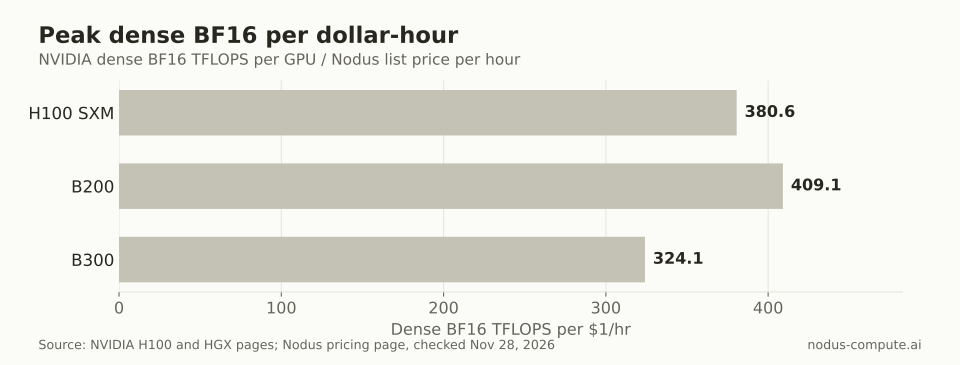 Per dollar, the B200 buys only 7% more peak BF16 math than the H100, and the B300 buys 15% less.
The B300 does not add BF16 throughput over the B200. NVIDIA lists the same 36 PFLOPS for both systems. Its gains are in FP4 (108 dense PFLOPS per system against 72), attention performance, which NVIDIA lists at 2x the B200, and memory. A BF16 or FP8 training job that fits on an H100 gets the least from it.
How much faster does Blackwell have to be to cost less?
Section titled “How much faster does Blackwell have to be to cost less?”Exactly as much faster as it is more expensive. Cost per finished run is the hourly rate times the hours the run takes. So a B200 run costs 2.115 / speedup times the H100 run, and a B300 run costs 2.670 / speedup. That gives a simple rule: a Blackwell GPU is cheaper only when its measured speedup on your job beats the price ratio.
| Speedup over H100 (your assumption) | B200 cost vs H100 | B300 cost vs H100 |
|---|---|---|
| 1.5x | 1.410x | 1.780x |
| 2.0x | 1.058x | 1.335x |
| 2.5x | 0.846x | 1.068x |
| 3.0x | 0.705x | 0.890x |
| 3.5x | 0.604x | 0.763x |
| 4.0x | 0.529x | 0.668x |
Each cell is the price ratio divided by the speedup, using the Nodus rates above. The speedups are round numbers for you to replace with your own measurement, not benchmarks.
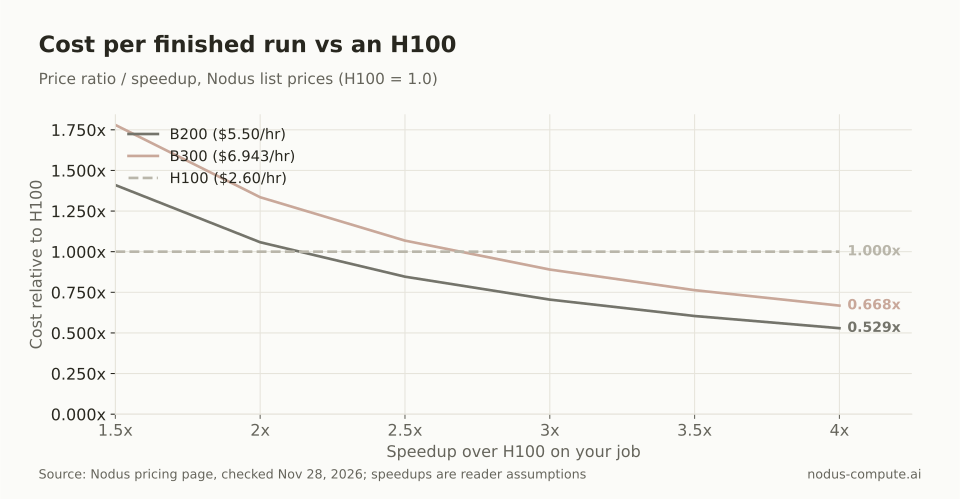 The B200 starts saving money above 2.115x; the B300 needs 2.670x.
Now put a published speedup in. In MLPerf Training v6.0, 64 B200s trained Llama 3.1 8B and gpt-oss-20b 2.04x and 2.08x faster than 64 H100s, per the MLCommons results; our B200 vs H100 comparison walks through those runs.
Take a 400 H100-hour fine-tune, 8 x H100 for 50 hours: 8 x $2.60 x 50 = $1,040. At 2.08x, the B200 finishes in 24.0 hours for 8 x $5.50 x (50 / 2.08) = $1,057.69, about 2% more. At 2.04x it is $1,078.43.
If a B300 only matched the B200’s 2.08x on that job, which is plausible for BF16 math NVIDIA lists as identical, it would cost 8 x $6.943 x (50 / 2.08) = $1,335.19, 28% more than the H100. For this kind of job the H100 is the cheapest of the three, and the B200 buys you 26 hours for about $18.
When does Blackwell actually win?
Section titled “When does Blackwell actually win?”When the job stops looking like a dense BF16 workload that fits in 80 GB. Four cases clear the price ratio or make it irrelevant.
Memory is the most reliable one. If 180 GB per GPU fits a model on one B200 node that needs two H100 nodes, one node at $44.00/hr replaces two at $41.60/hr, and you lose the network hop between them. The B200 vs H100 post works through a 60B full fine-tune that lands exactly there. Removing activation recomputation or CPU offloading has the same effect on a smaller scale.
High-volume inference is the second. NVIDIA’s H100 page cites SemiAnalysis InferenceX figures from April 2026: about $0.02 per million tokens on B200 with TensorRT-LLM against $0.09 on H100 with vLLM for GPT-OSS-120B, roughly 4.5x cheaper.
Read that carefully. The two runs used different serving software and different per-user speeds (55 against 66 tokens per second), and the cost uses SemiAnalysis’s hourly assumptions, not Nodus rates. The test for you is still the table above: does a B200 serve more than 2.115 times the tokens per hour of an H100 at your latency target, on your stack?
Large-scale claims are the third. The DGX B200 page claims 3X the training and 15X the inference performance of DGX H100. Its footnotes describe projections at very large scale and long contexts, so treat them as upper bounds for those settings, not single-node estimates.
Deadlines are the fourth. If the run gates a launch, paying 2% more to finish in 24 hours instead of 50 is an easy trade.
Where does the H100 beat even the B300?
Section titled “Where does the H100 beat even the B300?”Double-precision scientific computing. NVIDIA lists 67 TFLOPS of FP64 Tensor Core throughput on the H100 SXM. The HGX page lists 296 TFLOPS for an 8-GPU B200 system, 37 per GPU, and 10 TFLOPS for an 8-GPU B300 system, 1.25 per GPU. Per GPU, the H100 does 1.8 times the FP64 math of a B200 for less than half the price.
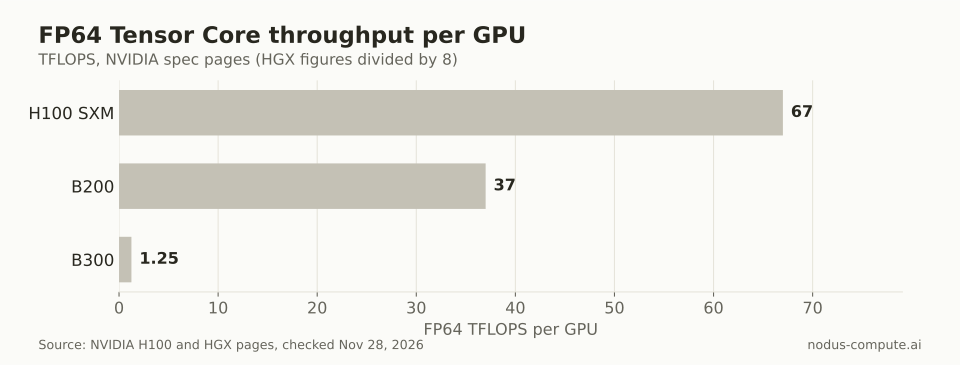 For FP64 simulation and solver work, the H100 is the newer GPU in all but name.
If your workload is molecular dynamics, CFD or a linear solver in FP64, a Blackwell upgrade can be a step backward. Check your code’s precision before you move.
How do you pick between H100 and Blackwell on Nodus?
Section titled “How do you pick between H100 and Blackwell on Nodus?”Measure one short run on each, then let the price ratio decide. Run a few hundred steps, record steps per second, and divide. If the ratio clears 2.115x for B200 or 2.670x for B300, move. If it does not, stay, unless memory or a deadline changes the math.
You can see current rates and availability before you launch, as shown in our GPU guide:
$ nodus get gpus --gpu H100 --count 8 --region usA Nodus Job can also list every accelerator you accept in resources.gpu.type, and the scheduler picks among them by expected cost to finish. For long H100 runs, the waste levers in our post on why the H100 is so expensive usually save more than a GPU upgrade.
When will the H100 become obsolete?
Section titled “When will the H100 become obsolete?”Not soon in software terms. CUDA 13.0 dropped Volta, so support ends generations behind the newest part, and Hopper still receives library optimizations in CUDA 13.5. Price, not support, is what will eventually push most jobs off it.
Is the H200 a better middle ground than the B200?
Section titled “Is the H200 a better middle ground than the B200?”Sometimes. Nodus lists the H200 SXM, with 141 GB, at $3.593/hr, so it fixes the H100’s memory limit for 1.38 times the price rather than 2.115. Our H100 vs H200 guide covers when that memory pays for itself.
Can the H100 run FP4 models?
Section titled “Can the H100 run FP4 models?”Not on Tensor Cores. NVIDIA lists FP8 and INT8 as the H100’s lowest Tensor Core precisions, while the B200 and B300 add FP4. FP4 weights can still be dequantized on an H100, but you give up the speed that makes FP4 worth using.
Is the B300 worth it over the B200?
Section titled “Is the B300 worth it over the B200?”Only for work that uses what it adds: FP4 inference, attention-heavy long contexts or 288 GB per GPU. For BF16 math NVIDIA lists the two systems as equal, and the B300 costs 26% more on Nodus. Our B300 vs B200 comparison goes deeper.
More from the blog
image-generation6 min read
How do you evaluate a text-to-image model beyond image quality?
A beautiful image can still fail the brief. Count usable results per request, check object relationships and compare models under the same selection budget.
Read the postspot9 min read
Can you run LLM inference on spot GPUs safely?
Batch inference on spot GPUs is safe. Online serving is safe only with an on-demand floor, spread replicas and a drain on notice. The rule and math.
Read the post