
How much does an NVIDIA B200 cost to buy or rent?
NVIDIA B200 price: $5.50 to $7.99 per GPU-hour on demand, or $591,114.20 for an 8-GPU DGX B200. Buying beats Nodus above about 60% utilization.
An NVIDIA B200 costs $5.50 to $7.99 per GPU-hour on demand, and Nodus lists it at $5.50/hr, the lowest of the four rates we checked. To buy one, you buy an 8-GPU system: one US reseller lists the DGX B200 at $591,114.20, or $73,889.28 per GPU. Nodus runs your job on the cheapest capacity that will finish it, so you pay for the GPU-hours you use, not for a machine that waits.
Buying beats that rate only if all eight GPUs stay busy more than about 60% of the time for three years. The rest of this post shows that math once, with every input you can change: the purchase price, the running cost of owned hardware, a priced 72-hour job and a utilization rule for deciding.
Why can’t you just buy one B200?
Section titled “Why can’t you just buy one B200?”Because NVIDIA sells it as part of an 8-GPU board, not as a card. The B200 is an SXM module that ships on NVIDIA HGX baseboards and in the DGX B200, which NVIDIA lists with eight GPUs, 1,440 GB of HBM3e and about 14.3 kW of maximum system power.
That is also why the memory figure varies. Each B200 in an 8-GPU system has 180 GB, while NVIDIA quotes 192 GB as Blackwell’s maximum. Our B300 vs B200 breakdown covers the spec sheet in detail.
The closest thing to a chip price is NVIDIA’s own estimate. CEO Jensen Huang told CNBC in March 2024 that Blackwell would cost between $30,000 and $40,000 per unit. That is a range for the GPU, not a price you can pay for a working machine.
What does a B200 server cost to buy?
Section titled “What does a B200 server cost to buy?”A complete DGX B200 is listed at $591,114.20 before tax on Broadberry’s configurator, against a stated RRP of $738,892.75. That default configuration includes three years of NVIDIA Business Standard support and installation. Divided by eight, it is $73,889.28 per GPU.
We did not find a public list price from NVIDIA itself. Treat the Broadberry figure as one dated, public data point. A large order or a different vendor may come in lower.
The server is not the whole bill. Owned hardware also needs power, cooling, rack space, high-speed networking and someone to run it. Those costs depend on where you put the machine, so we treat them as an input you set, not a fact.
How much does it cost to rent a B200 by the hour?
Section titled “How much does it cost to rent a B200 by the hour?”On demand, $5.50 to $7.99 per GPU-hour across the four platforms we checked. All four bill by time used, but the shapes differ.
| Platform | Listed B200 rate | One 8 x B200 job, 72 hours | Owned DGX B200 breaks even at |
|---|---|---|---|
| Nodus | $5.50/hr | $3,168.00 | 60.2% utilization |
| Modal | $0.001736/sec ($6.25/hr) | $3,599.77 | 53.0% utilization |
| Lambda, 8-GPU instance | $7.69/hr per GPU | $4,429.44 | 43.1% utilization |
| RunPod, Secure Cloud Pod | $7.99/hr | $4,602.24 | 41.4% utilization |
Prices checked November 8, 2026, GPU time only: listed at $5.50/hr on the Nodus pricing page; Modal pricing per second, with CPU and memory billed separately; Lambda pricing for the 8-GPU HGX B200 instance, a rate the page lists as taking effect November 16, 2026 (a single B200 SXM6 is listed at $7.99/hr); RunPod pricing for a B200 Pod. The Modal job cost uses the per-second rate, not the rounded hourly figure.
The job column is 8 GPUs for 72 hours, which is 576 GPU-hours times each rate. A three-day fine-tune at that size costs $3,168.00 on Nodus and $4,602.24 at the highest rate here.
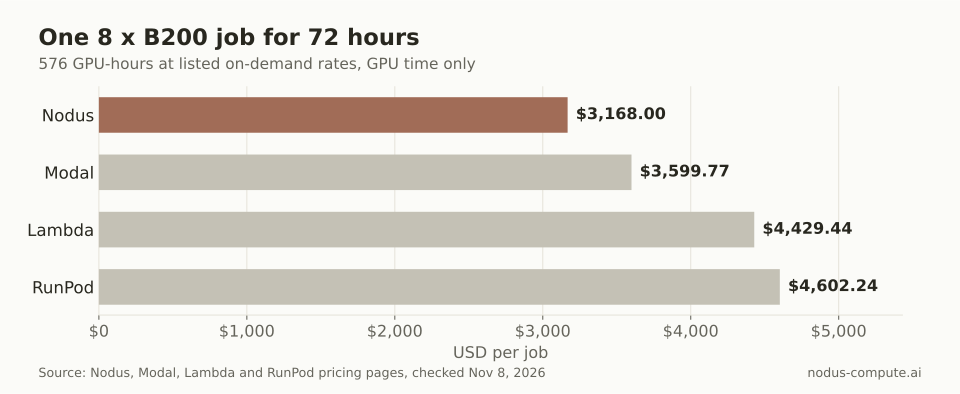 The same 576 GPU-hours cost $1,434.24 more at the highest listed rate than at the lowest.
For the cost per finished job, including startup, idle time and redone work, see what an H100 or B200 hour costs per finished job.
How many hours before buying a B200 beats renting?
Section titled “How many hours before buying a B200 beats renting?”Divide the total cost of owning by the hourly rate for the same eight GPUs. Here is the arithmetic once, with our assumptions labeled.
Hardware: $591,114.20, spread over the three years its support covers. Three years is 26,280 hours, so the machine costs $22.49 for every hour it exists, or $2.8116 per GPU-hour.
Running cost, our assumption: $4.00 per node-hour for power, cooling, rack space and network. Power alone at the 14.3 kW maximum and an assumed $0.12/kWh is $1.72 an hour, and the rest covers hosting. Swap in your own numbers. This leaves out staff time, financing and resale value.
Total: $591,114.20 plus $4.00 x 26,280 hours is $696,234.20 over three years. That is $3.3116 per GPU-hour if all eight GPUs work every hour.
Break-even utilization is that figure divided by the rate you would otherwise pay:
- Against Nodus at $5.50: $3.3116 ÷ $5.50 = 60.2%, or 15,824 of the 26,280 hours.
- Against Modal at $6.25: 53.0%.
- Against Lambda at $7.69: 43.1%.
- Against RunPod at $7.99: 41.4%.
With hardware only and no running cost, the thresholds drop to 51.1%, 45.0%, 36.6% and 35.2%. That is the floor before a single watt of power is paid for.
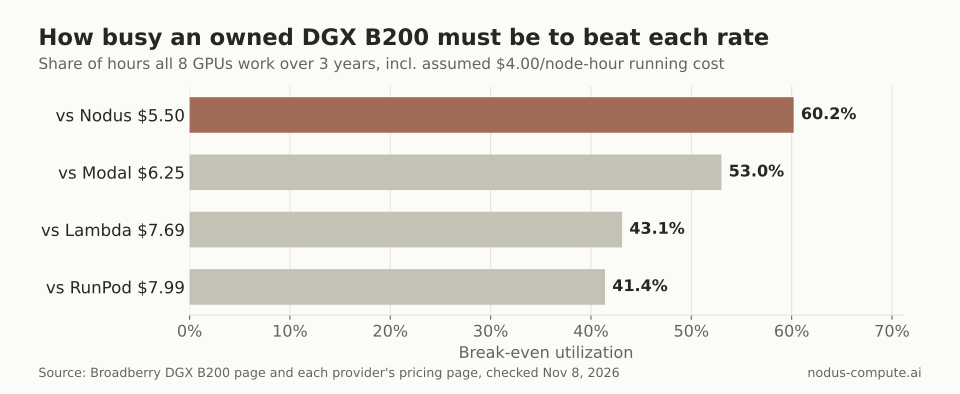 The cheaper the hourly rate you can get, the busier an owned machine has to be to win.
What does a part-time B200 cost if you own it?
Section titled “What does a part-time B200 cost if you own it?”The full monthly bill, every month, whether the GPUs work or not. Spread over 36 months, the $696,234.20 is about $19,340 a month. Paying by the hour scales with use instead, at 730 hours a month.
| Utilization | Owned DGX B200 | Nodus, 8 x $5.50 | RunPod, 8 x $7.99 |
|---|---|---|---|
| 0% | $19,340 | $0 | $0 |
| 25% | $19,340 | $8,030 | $11,665 |
| 50% | $19,340 | $16,060 | $23,331 |
| 75% | $19,340 | $24,090 | $34,996 |
| 100% | $19,340 | $32,120 | $46,662 |
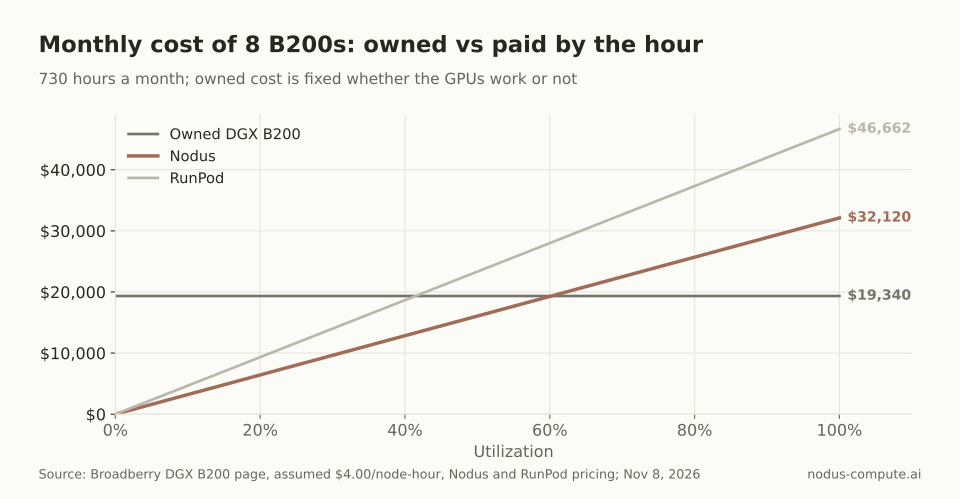 Owning is a fixed bill; the lines cross where the GPUs are busy enough to earn it.
Now run the 72-hour job once a month on the owned machine. It uses 576 of the 5,840 GPU-hours you paid for, so each used GPU-hour costs $19,339.84 ÷ 576 = $33.58. That is about six times the Nodus rate. A part-time B200 is the most expensive way to own one.
Our rule: if you cannot point to work that keeps all eight GPUs busy more than 60% of the time for three years, pay by the hour. Above that, owning is cheaper on paper, and the next question is whether you want to run a data center.
When is buying, or another provider, the better choice?
Section titled “When is buying, or another provider, the better choice?”Buying wins when the work is steady and predictable. A team that trains or serves around the clock for years, has cheap power and an existing facility, or must keep data on its own hardware will clear the threshold. A large order can also beat the list price we used, which lowers every number above.
Owning and paying by the hour also combine. Nodus pools let you enroll your own machines so jobs land on them first and burst to other capacity under rules you set. A pool carries a routing fee that you agree to when you create it:
nodus create pool lab --routing preferAmong the hourly options, pick by how you work:
- Modal fits teams that already deploy Python functions on Modal and want B200s with the same per-second billing.
- Lambda lists clusters of 16 to 2,000+ B200s on terms from two weeks to a year, for teams that want a large dedicated cluster.
- RunPod fits teams that want a Pod they control directly, with the vCPUs and RAM listed beside each GPU.
- Nodus fits jobs you want run at the lowest listed B200 rate here, with a hard cost cap, checkpoints and automatic recovery when capacity is lost.
For a long fixed commitment, Nodus also offers Reserved Compute (Beta): capacity supplied by Nodus for an agreed configuration and reservation window.
How do you price a B200 job on Nodus before running it?
Section titled “How do you price a B200 job on Nodus before running it?”Ask for the GPU in a manifest, then dry-run it. The GPU guide lists B200 as an alias, and count is per machine:
spec: resources: gpu: {type: [B200], count: 8}$ nodus apply -f job.yaml --dry-run=server -o estimateThe dry run starts nothing. It shows the offering Nodus would use, the expected cost at p50 and p90 and the startup time. When nothing fits, it says why, for example CapacityUnavailable or ExceedsRemainingBudget. Add maxCostUSD to the Job and it suspends at that cap instead of spending past it.
Is a B300 a better buy than a B200?
Section titled “Is a B300 a better buy than a B200?”This post prices only the B200 purchase. Per hour, Nodus lists the B300 at $6.943 against $5.50 for the B200, and our B300 on-demand guide covers where to get one by the hour.
Does the break-even change if I sell the server after three years?
Section titled “Does the break-even change if I sell the server after three years?”Yes, resale lowers the effective hardware cost and the threshold with it. Subtract your expected resale price from $591,114.20 before dividing by 26,280 hours. We left it out because nobody can quote a used B200 price three years out.
Should I buy a B200 for running models at home?
Section titled “Should I buy a B200 for running models at home?”No. A DGX B200 draws up to 14.3 kW and needs data center power and cooling. For a desk machine, see running an LLM locally vs in the cloud, which prices consumer GPUs against hourly rates.
Can interruptible capacity lower the hourly B200 rate further?
Section titled “Can interruptible capacity lower the hourly B200 rate further?”On Nodus, set placement.interruptible: Allow and it uses interruptible capacity only when that is cheaper to finish, restoring from checkpoints if a machine is reclaimed. Any lower hourly rate pushes the break-even utilization for buying even higher.
More from the blog
gpu7 min read
Is an RTX 5090 good for AI compared with an A100 or H100?
An RTX 5090 is the cheapest GPU per finished job for AI work that fits in 32 GB. Specs, cost math and when an A100 or H100 is worth it.
Read the postagents9 min read
How do you run AI agent evals in parallel on cloud GPUs?
Run each agent eval episode in its own sandbox with a per-run cap and a batch cap, grade answers separately, and size the batch for a useful error bar.
Read the post