
How can an AI startup get free GPU and cloud credits?
The startup credit programs that can pay for GPUs, who qualifies, the order to apply in, and how many H100 hours a credit stack really buys.
Most free GPU time for an AI startup comes from AWS Activate, the Google for Startups Cloud Program and Microsoft for Startups, with smaller grants from GPU providers such as RunPod. Nodus can run your training and fine-tuning jobs inside your own credited AWS, Google Cloud or Azure account (Beta), spending those credits first and moving to Nodus capacity when they run out. The catch is that a credit is only worth the GPU hours it buys before it expires, and quota waits, high list prices and expiry dates all shrink that number.
We build Nodus. Every program fact below links to the program’s own page, the GPU arithmetic is shown once, and we checked each page on November 13, 2026. If you are still choosing a platform rather than chasing credits, read the best GPU cloud for an AI startup first.
Which startup credit programs can actually pay for GPUs?
Section titled “Which startup credit programs can actually pay for GPUs?”The three hyperscalers are the only programs that reach six figures, and all three cover their own GPU virtual machines. GPU providers give less, but their credits go straight to GPU time.
| Program | Credits | Who qualifies | How you apply | Expiry |
|---|---|---|---|---|
| AWS Activate Founders | $1,000, up to $5,000 for select startups | Self-funded, founded in the last 10 years, pre-Series B | Directly | “Usually” 1 to 2 years, by package |
| AWS Activate Portfolio | Up to $200,000 | Backed by an Activate Provider, pre-Series B, round in the last 12 months | With your provider’s Org ID | Same |
| Google for Startups, Start tier | $2,000 | Founded in the past 2 years, working MVP, plans to raise | Directly | Not stated |
| Google for Startups, AI tier | Up to $250,000 in year 1, up to $100,000 more in year 2 | Pre-seed or seed in the last 5 years or Series A in the last 12 months, building on Gemini | Directly, investors can verify stealth teams | Over 2 years |
| Microsoft for Startups | Up to $5,000 after business verification, up to $150,000 over time | Early-stage software startups | Directly | Not stated |
| RunPod Startup Program | $1,000 (raised under $1M), $5,000 (verified VC), bonus on $25,000+ commits | By funding raised | Online form | 1 year after issue |
| Modal for Startups | Not published | New to Modal, seed to Series A via partner VCs or over $1M raised | Online form | Not stated |
Programs checked November 13, 2026. AWS’s eligibility details come from its Activate credits guide. Google’s year-2 line reads “20% up to an additional $100,000”; startups that are not AI-first get up to $100,000 in year 1.
A few details in that table decide more than the headline amount. Activate Providers include accelerators, angel investors and VC firms, and AWS names Y Combinator, Sequoia and Andreessen Horowitz among them. Google’s AI tier is designed for startups that “use or plan to use Gemini” as a foundation of their product. It also excludes teams that already received more than $5,000 in Google Cloud credits. AWS also runs an invite-only tier of $200,000 or more for AI startups after Activate Portfolio, reached through an account manager.
Does NVIDIA Inception give you cloud credits?
Section titled “Does NVIDIA Inception give you cloud credits?”Not directly. NVIDIA Inception is a free program with no fees or equity, open at any funding stage. Members must be incorporated, under 10 years old, have a working website and a clear use for NVIDIA technology.
Its credit benefit is access: members can request “free cloud credits from NVIDIA and partners” through the Inception portal, with amounts set per offer and not published. The other benefits are training courses, VC introductions and preferred hardware pricing, which NVIDIA describes as a rebate on the supplier’s price. Join it because it costs nothing, but do not plan your compute budget around it.
In what order should a startup apply for credits?
Section titled “In what order should a startup apply for credits?”Apply in the order your funding windows close, and only when you have work ready to run. Credits start expiring when they are issued, and several programs gate on how recent your last round was. This is our decision rule, built from the eligibility lines above.
- No investor yet. Apply to Microsoft for Startups first, since business verification gets you up to $5,000, the largest starting grant here for a team without investors. Add Google’s $2,000 Start tier if you were founded in the last two years, and AWS Activate Founders for $1,000. Join NVIDIA Inception, and RunPod’s $1,000 Starter tier if you want its pods or serverless endpoints.
- Accelerator or seed fund. Ask whether your backer is an AWS Activate Provider and get its Org ID, because Portfolio credits must be claimed within 12 months of your latest round. Apply to Google’s AI tier in the same quarter if you build on Gemini. Pick the cloud where your first real training run will happen and apply there first.
- Series A or later. Google’s AI tier needs the Series A to be under 12 months old, so apply right after the round closes. AWS Activate stops at pre-Series B, and its larger AI tier is invite-only through your account manager. A RunPod Growth commit is a discount on prepaid spend, not free compute.
One rule covers all three stages. Never take a grant you cannot spend before it expires on a GPU you can actually get.
How many H100 hours does a credit stack really buy?
Section titled “How many H100 hours does a credit stack really buy?”Far fewer than the dollar figure suggests, because hyperscaler on-demand GPU prices are high. We priced one NVIDIA H100 hour on each cloud’s own listed on-demand rate for its 8 x H100 machine.
| Cloud | 8 x H100 machine | Listed price per hour | Per H100-hour |
|---|---|---|---|
| AWS, p5.48xlarge (US East, N. Virginia) | 8 x H100 | $55.04 | $6.88 |
| Google Cloud, a3-highgpu-8g | 8 x H100 | $88.49 | $11.06 |
| Azure, ND96isr H100 v5 (East US) | 8 x H100 | $98.32 | $12.29 |
Prices checked November 13, 2026 on AWS EC2 on-demand pricing, Google Cloud accelerator-optimized pricing and the Azure retail prices API behind Azure’s Linux VM pricing page. Per H100-hour is the machine price divided by 8.
Take a seed-stage AI startup with an Activate Provider behind it that wins the year-1 maximum on AWS and Google, plus Microsoft’s $5,000 verification tier. That is $455,000 of credit.
- AWS: $200,000 / $6.88 = 29,069.8 H100-hours.
- Google Cloud: $250,000 / $11.06125 = 22,601.4 H100-hours.
- Azure: $5,000 / $12.29 = 406.8 H100-hours.
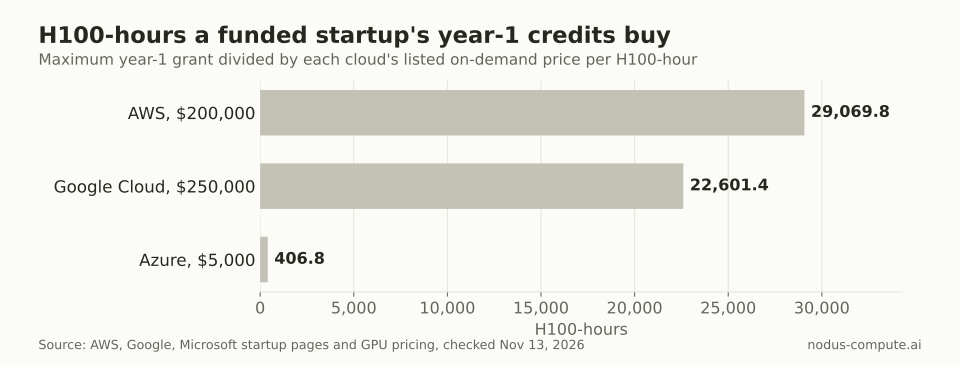 A $455,000 stack buys about 52,078 H100-hours, roughly one 8-GPU machine running for 271 days.
The total is 52,078.0 H100-hours, or 6,509.8 hours of one 8 x H100 machine, which is 271.2 days of continuous use. At Nodus’s listed $2.60 per H100-hour, the same 52,078.0 hours would cost about $135,403. That is the honest way to value a credit stack: in GPU-hours at a price you could otherwise pay, not in the headline dollars.
A team with no investor gets a much smaller stack: $1,000 from AWS, $2,000 from Google and $5,000 from Microsoft.
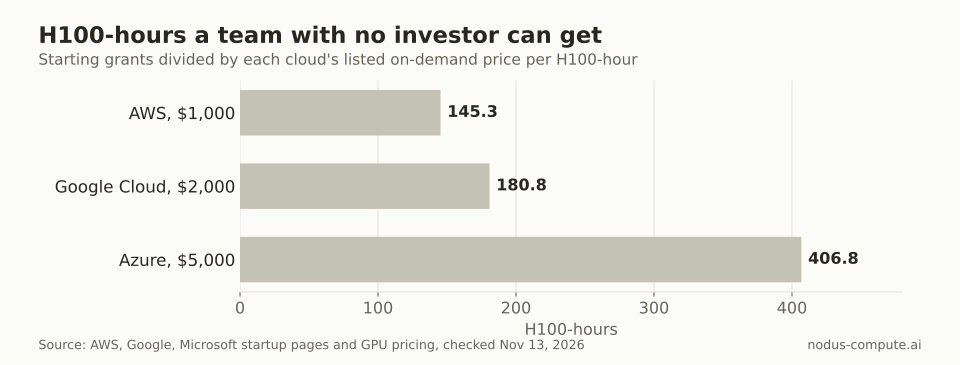 Without an investor, Microsoft’s verification tier buys more H100 time than the AWS and Google grants combined.
Those three grants buy 145.3, 180.8 and 406.8 H100-hours, 733.0 in total. That is one 8 x H100 fine-tune of about 92 hours, which is real work but not a training budget.
Which gotchas make startups lose their credits?
Section titled “Which gotchas make startups lose their credits?”Most lost credit comes from four rules in the programs’ own terms and docs, not from bad luck.
- GPU quota starts at zero on AWS. The default quota for “Running On-Demand P instances”, the family that includes H100 machines, is 0 vCPUs, so you must request an increase before credits can buy any H100 time. Google gives new projects a global GPU quota and asks you to request more per GPU model and region. Azure grants GPU machines through per-family vCPU quota requests.
- Credits expire while you wait. AWS says Activate credits “usually expire within 1-2 years”, and RunPod credits expire one year after issue. Apply when the quota request and the workload are ready, not on the day you hear about the program.
- Marketplace and support are excluded. AWS promotional credit terms exclude AWS Marketplace, enterprise support tiers and upfront fees for Savings Plans and Reserved Instances. Google excludes all third-party products, including Marketplace and Model Garden listings. Microsoft excludes support plans, Marketplace purchases and third-party models.
- You cannot steer AWS credits. They apply automatically to all eligible charges, so a forgotten database or idle machine eats the same balance as your training runs.
How does Nodus help you spend cloud credits first?
Section titled “How does Nodus help you spend cloud credits first?”Nodus can run your jobs in your own connected AWS account, GCP project or Azure subscription, so it spends your cloud credits before Nodus capacity. This is a Beta feature described in the cloud accounts docs.
Connecting starts read-only. For AWS, the role Nodus assumes can only list instances, read daily cost, read your credit balance and expiry, and read GPU quotas. That last point matters here: you see the credit left, the date it expires and whether your quota can take an H100 job in one place.
Running work is a separate upgrade with a spending limit you set. Single-node Jobs and TrainingJobs then go to your connected accounts first. When the account is full or out of credit, the default behavior runs the work on Nodus capacity at Nodus rates.
You can instead make Jobs wait for your approval or wait for your account. The job page shows whether each attempt ran in your account or on Nodus capacity.
For a GPU job in your own account, Nodus charges a route fee of $0.02 per device-hour, and your cloud bills the machine and disk against your credits. Multi-node runs and Sandboxes use Nodus capacity.
What should you use when the credits run out?
Section titled “What should you use when the credits run out?”Pay the lowest rate for work that finishes. Nodus lists an H100 at $2.60 per hour on the pricing page, against the $6.88 to $12.29 per H100-hour hyperscaler list prices above.
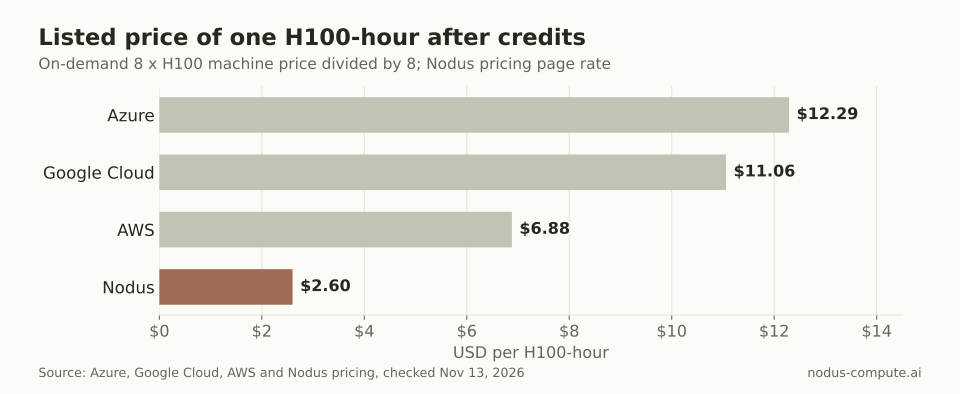 After credits, the same dollar buys 2.65 times more H100 time at Nodus’s listed rate than at AWS on-demand.
The 2.65 comes from $6.88 / $2.60. List price is not the whole bill, and we break down idle time and failed runs in what an H100 or B200 hour really costs per finished job. Nodus has no public starter credit right now: its credits guide says the $30 starter offer has ended, so new accounts add prepaid credit or redeem an approved promo code. If an agent launches your jobs, cap its spending first, as we show in how to limit an AI agent’s GPU spending.
Can you stack AWS, Google and Microsoft startup credits?
Section titled “Can you stack AWS, Google and Microsoft startup credits?”Yes, across clouds, because each program sets its own eligibility. Within a program the credits stay with you: Google says they may only be used by the original applicant and cannot be shared, split or resold.
Can Google startup credits pay for the Gemini API?
Section titled “Can Google startup credits pay for the Gemini API?”Yes. Google’s program credits cover its own models such as Gemini and Gemma, while third-party models are billed directly and not covered.
Do I need a VC to get AWS Activate credits?
Section titled “Do I need a VC to get AWS Activate credits?”No. Activate Founders is for self-funded startups and starts at $1,000. The $200,000 Portfolio tier needs an Org ID from an Activate Provider such as an accelerator, angel investor or VC.
Does Nodus give startup credits?
Section titled “Does Nodus give startup credits?”The public $30 starter credit has ended. Nodus applies any credit grant you hold, such as a promo code, before purchased credit, soonest expiry first.
More from the blog
inference6 min read
How do you evaluate an LLM classifier when positive cases are rare?
High accuracy can hide an unusable review queue. Compare classifier operating points at the expected positive rate, then check recall and review capacity together.
Read the postgpu9 min read
How do you fine-tune Qwen with LoRA in the cloud cheaply?
Which Qwen3, Qwen3.5 and Qwen3.8 sizes fit LoRA or QLoRA on one GPU, the chat-template traps, and what each size costs per hour on Nodus.
Read the post