
LLM distillation vs fine-tuning: which should you use?
Distill when a big model already does your task well; fine-tune when the right answers only exist in your labels. Cost math, break-even and a decision rule.
Use distillation when a large model already does your task well and the problem is what it costs to serve; use fine-tuning when the right answers exist only in your own labelled data. Nodus runs both as managed TrainingJobs (Beta), nodus/distill and nodus/sft, each priced before it starts and stoppable at a dollar cap you set. GPU time costs under $20 on either path in our worked example, so the real decision is who writes the labels: a teacher model at a fraction of a cent each, or people at dollars each.
Distillation is really fine-tuning where a bigger model writes the targets. Seen that way, the choice and the cases for doing both get much simpler.
What is the actual difference between distillation and fine-tuning?
Section titled “What is the actual difference between distillation and fine-tuning?”The difference is where the target answers come from. Fine-tuning trains a model on examples you collected and labelled, so it can learn behavior no existing model shows. Distillation trains a small student on outputs from a larger teacher, so it can learn to copy behavior the teacher already has, at a lower serving cost.
Google’s machine learning course describes the common form of distillation as using bulk inference from a teacher to label data, then training a smaller student on it. The same page notes that a distilled model’s predictions are generally not quite as good as the larger model’s. OpenAI’s supervised fine-tuning guide describes the same flow: distill a large model’s results to create training data for a smaller one.
So a student is roughly capped at its teacher’s quality on your task. A fine-tuned model can beat every off-the-shelf model, if your labels are good. If you want the mechanics of soft labels, sequence-level and on-policy methods, our guide to how LLM distillation works covers each one and what it costs.
When does distillation beat fine-tuning on your own labels?
Section titled “When does distillation beat fine-tuning on your own labels?”Distillation wins when a large model already passes your eval, you have plenty of real unlabelled prompts, and a smaller model would save real serving money. Then the teacher can label tens of thousands of examples for the price of a few GPU-hours, which no human labelling budget can match.
Research backs the idea that a large model’s outputs help a small model learn more from fewer labelled examples. In Distilling Step-by-Step (Hsieh et al., 2023), the authors trained small models on a large model’s labels and rationales. Their 770M T5 model beat a few-shot prompted 540B PaLM model on one benchmark using 80% of the available data. Standard fine-tuning of the same T5 model could not match PaLM even with 100% of the dataset.
Fine-tuning on your own labels wins when the teacher is wrong in ways that matter. Examples are your company’s support policy, a house style for legal summaries, or a label scheme only your reviewers understand. Copying a teacher that gets those wrong just bakes in its mistakes, faster and cheaper.
What does each path cost, worked through?
Section titled “What does each path cost, worked through?”We priced one scenario to compare the paths on the same footing. The inputs marked illustrative are assumptions for the example, not measurements; replace them with your own.
- Today you serve Qwen3-32B on 2 NVIDIA H100 SXM GPUs around the clock (illustrative traffic).
- The goal is a Qwen3-8B model that handles the same traffic on 1 NVIDIA L40S (illustrative).
- You have 40,000 real prompts; each prompt plus answer is about 500 tokens, so 20M tokens (illustrative).
- People cost $2 per reviewed or labelled example, about 2 minutes at $60 an hour (illustrative).
- Both paths need a 1,000-example human eval set, $2,000 in reviewer time.
The model sizes are public. Qwen3-32B has 32.76B parameters and Qwen3-8B has 8.19B, both Apache 2.0, per their Hugging Face pages (32B, 8B).
For compute we used the Kaplan et al. approximations: 2 x parameters FLOPs per token to generate, 6 x parameters to train. NVIDIA lists the H100 SXM at 1,979 teraFLOPS of BF16 with sparsity, so about 989 dense. We assume 30% utilization for training and 10% for token-by-token generation, which is slower. The H100 SXM is listed at $2.60/hr on the Nodus pricing page.
Distillation path:
- Teacher writes answers for 40,000 prompts: 2 x 32.76B x 20M = 1.31 x 10^18 FLOPs, 3.68 H100-hours at 10%, $9.57.
- Student training, 2 epochs over 20M tokens: 6 x 8.19B x 40M = 1.97 x 10^18 FLOPs, 1.84 H100-hours at 30%, $4.79.
- Eval set: $2,000. Total: $2,014.36.
Fine-tuning path:
- 4,000 human-labelled training examples: $8,000, plus the $2,000 eval set.
- Student training, 3 epochs over 2M tokens: 2.95 x 10^17 FLOPs, 0.28 H100-hours, $0.72. Total: $10,000.72.
Fine-tune the teacher, then distill:
- The same $10,000 of labels and eval, plus $2.87 to train Qwen3-32B for 3 epochs on the 4,000 examples (full-training FLOPs, an upper bound for LoRA), $9.57 of generation and $4.79 of student training. Total: $10,017.23.
| Path | People | GPU compute | One-time total |
|---|---|---|---|
| Distill from the 32B teacher | $2,000 | $14.36 | $2,014.36 |
| Fine-tune the 8B on your labels | $10,000 | $0.72 | $10,000.72 |
| Fine-tune the teacher, then distill | $10,000 | $17.23 | $10,017.23 |
Prices checked November 24, 2026 on the Nodus pricing page. Our arithmetic; illustrative inputs as listed above.
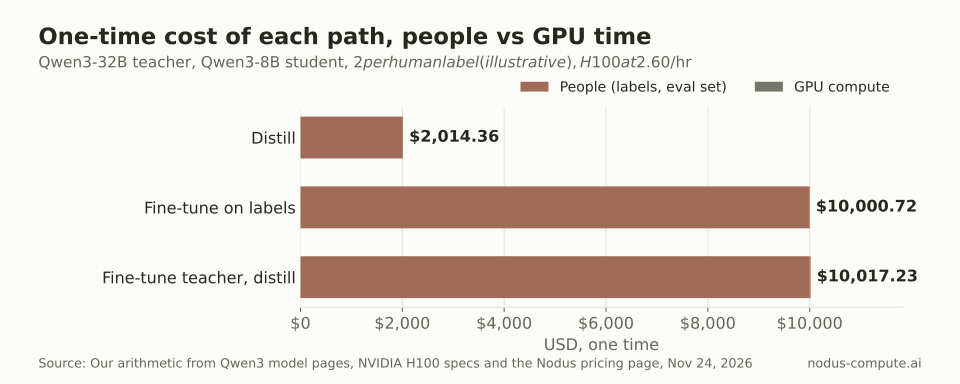 GPU time is under 1% of every path; the labels decide the bill.
The teacher’s labels cost $9.57 for 40,000 answers, about $0.00024 each. A human label in this example costs $2. That gap is the whole case for distillation, and it only holds when the teacher’s answers are right.
How fast do the serving savings pay it back?
Section titled “How fast do the serving savings pay it back?”At high traffic, every path pays back within a few months, and distillation pays back in weeks. Two H100 SXM GPUs for 730 hours a month at $2.60 cost $3,796.00. One L40S, listed at $0.793/hr on the Nodus pricing page, costs $578.89 for the same month. The saving is $3,217.11 a month, whichever path produced the 8B model.
Divide each one-time cost by that saving. Distillation pays back in 0.6 months, about 19 days. Fine-tuning on your labels pays back in 3.1 months, and fine-tune-then-distill also in 3.1 months.
| Month | Keep serving the 32B | Distilled 8B | Fine-tuned 8B |
|---|---|---|---|
| 0 | $0 | $2,014.36 | $10,000.72 |
| 1 | $3,796 | $2,593.25 | $10,579.61 |
| 3 | $11,388 | $3,751.03 | $11,737.39 |
| 6 | $22,776 | $5,487.70 | $13,474.06 |
Cumulative cost including the one-time cost. Our arithmetic from the Nodus pricing page, November 24, 2026.
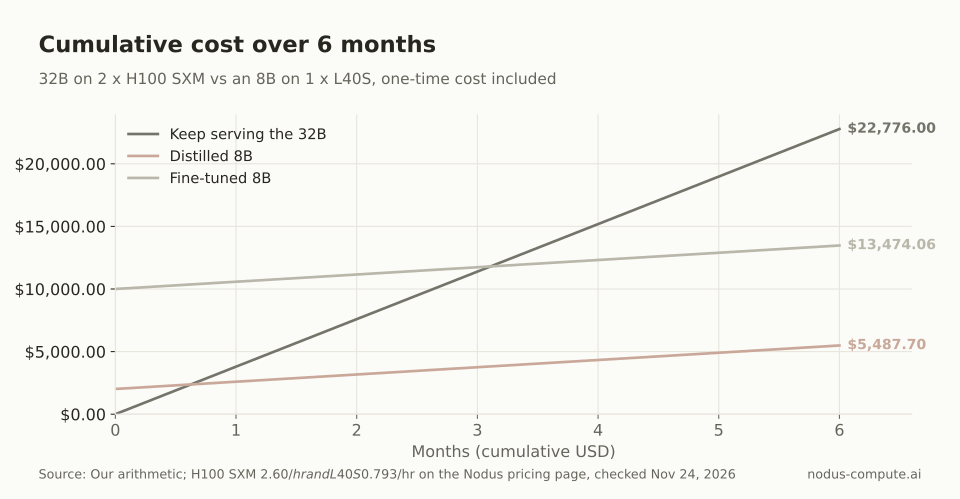 Both small models beat the 32B by month 4; the distilled one gets there in under a month.
Low traffic changes the answer. Suppose your current model bill is $800 a month (illustrative) and the 8B fits on one NVIDIA L4, listed at $0.43/hr on the Nodus pricing page, or $313.90 a month. The saving drops to $486.10. Distillation then pays back in 4.1 months, but fine-tuning on human labels takes 20.6 months, and fine-tune-then-distill 20.6 months as well.
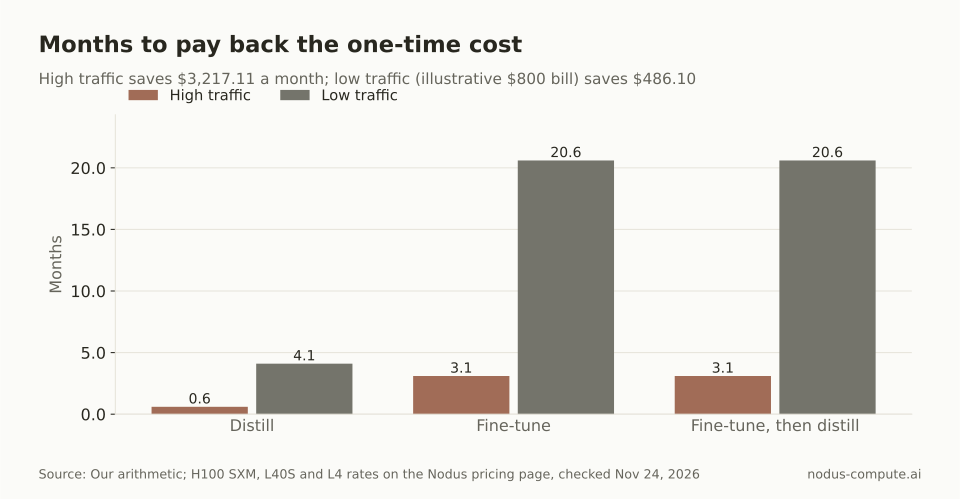 At low traffic, paying people for labels only to cut serving cost rarely pays back.
If quality is your reason to fine-tune, the payback is better answers rather than cheaper GPUs; our post on whether fine-tuning is worth it covers that case.
When should you do both?
Section titled “When should you do both?”Combine them when one source of labels is not enough. The two orders solve different problems.
Fine-tune the teacher, then distill, when you have a few thousand good labels but far more unlabelled prompts. The labels teach a large model your task, then the large model labels everything else for the student. You pay for people once and get the student’s serving cost. In our example that costs $16.51 more than fine-tuning the 8B directly, and the student learns from 40,000 examples instead of 4,000.
Distill, then fine-tune, when a general teacher gets you most of the way and a small labelled set covers the gaps. Distill first for breadth, then run a short supervised pass on your own labels for the cases the teacher gets wrong. Keep the labelled examples you train on separate from the ones you test on.
Whichever order you use, test the final student on held-out real traffic. A low training loss on teacher outputs only proves the student copies the teacher.
How do you decide? A rule you can use
Section titled “How do you decide? A rule you can use”This is the order we work through. It comes from the cost structure above: GPU time is cheap, people are not, and a student inherits its teacher’s mistakes.
- Build the eval set first, from real prompts with human-checked answers. Without it you cannot tell which path worked.
- Run the best large model you can use on that eval. If it passes and your monthly serving bill is high, distill.
- If no model passes, fine-tune. With fewer than a few thousand labels and many unlabelled prompts, fine-tune the large model first, then distill it.
- If a distilled student passes most of the eval but fails a specific slice, label that slice and fine-tune the student on it.
- If traffic is low and the large model passes, keep calling it. Neither path pays back quickly, as the low-traffic numbers show.
Check the teacher’s license or terms before step 2. Our distillation guide’s FAQ quotes the relevant terms for OpenAI’s API and the Llama 3.1 license.
How do you run either path on Nodus?
Section titled “How do you run either path on Nodus?”Both paths are TrainingJobs on Nodus, described in the training docs. For logit distillation, where the student matches the teacher’s token probabilities, nodus/distill takes a student, a teacher and your prompts. This is the example from the docs:
spec: runtime: nodus/distill model: {uri: hf://Qwen/Qwen3-0.6B@c1899de289a04d12100db370d81485cdf75e47ca} teacher: {uri: hf://Qwen/Qwen3-4B@0e9e39f249a16976918f6564b8830bc894c89659} data: {volume: chats} parameters: {temperature: 2.0} resources: {gpu: {type: [h100-sxm-80g], count: 2}}Logit distillation needs a teacher and student with the same tokenizer. Qwen3-32B and Qwen3-8B both list a vocabulary of 151,936 tokens in their Hugging Face configs, so the pair in our example qualifies. For the sequence-level path we priced, generate the teacher’s answers in a Job, then train the student with nodus/sft. The Jobs guide pattern is nodus run --gpu L4 --image nodus/pytorch -- python hello.py. Swap in your own script and GPU, and add --max-cost to stop at your budget.
Add maxCostUSD to any TrainingJob and run nodus apply -f sft.yaml --dry-run -o yaml to see the estimated cost before it runs. If the cap is reached, the run is suspended rather than failed, and raising the cap resumes it from its checkpoint. A model can come from one of your Volumes at a pinned revision, so a fine-tuning run can start from the student your distillation run produced. To decide between adapters and full weights for that pass, see LoRA vs full fine-tuning, and for the budget, how much fine-tuning costs.
Is distillation just fine-tuning on synthetic data?
Section titled “Is distillation just fine-tuning on synthetic data?”Sequence-level distillation is exactly that: supervised fine-tuning on answers a teacher wrote. Logit and on-policy distillation also pass the teacher’s probabilities over tokens, which carry more signal per example than one sampled answer.
Can a distilled model be better than its teacher?
Section titled “Can a distilled model be better than its teacher?”On a narrow task it can beat a teacher that was only prompted. In Distilling Step-by-Step, a 770M student beat few-shot prompted 540B PaLM on one benchmark. Do not plan on it: Google’s course notes distilled models are generally a little worse than the larger model.
Does RAG change this decision?
Section titled “Does RAG change this decision?”Retrieval solves a different problem: facts that change or need a citation. If your teacher passes the eval only because of retrieved context, the student needs the same retrieval at serving time. Our RAG vs fine-tuning guide covers that split.
Can I still fine-tune OpenAI models for distillation?
Section titled “Can I still fine-tune OpenAI models for distillation?”Only if you already have access. OpenAI’s fine-tuning guide says the platform is winding down, is no longer open to new users, and that eligible existing customers can create training jobs until January 6, 2027. Open-weight students trained on GPUs you pay for by the hour avoid that dependency.
How many teacher-labelled examples do I need?
Section titled “How many teacher-labelled examples do I need?”There is no fixed number; measure on your eval. Because teacher labels cost fractions of a cent, start with a few thousand, train, test, and double the set only while the eval score keeps rising.
More from the blog
gpu9 min read
What is the best GPU for Stable Diffusion and Flux?
Pick by VRAM: 16 GB for SD 1.5, SDXL and SD 3.5 Medium, 32 GB for Flux. Plus the hours of use before buying beats paying by the hour.
Read the postinference10 min read
How do you deploy an LLM to production on cloud GPUs?
Production LLM deployment is a checklist: evals, latency targets, replica math, warm capacity, safe rollouts, alerts and cost per 1M tokens.
Read the post