Improve how models learn.
Agents test training recipes, data choices, optimizers, and implementation changes. The question: which changes improve model quality within the same compute budget?
Nodus ResearchResearch agenda
We’re building an agentic research lab to lower the cost of training and serving AI. Agents write code, run experiments, and evaluate changes across training, reinforcement learning, and inference systems.
Code changes become experiments. Results guide the next change.
Our research objective is better model performance per unit of compute. Agents explore changes across the model lifecycle, with quality, latency, and cost measured together.
Agents test training recipes, data choices, optimizers, and implementation changes. The question: which changes improve model quality within the same compute budget?
Agents iterate on reward design, rollout strategies, and policy updates. Evaluate each change on the task it needs to solve and the compute it takes to learn.
Agents experiment with batching, caching, quantization, and execution paths. Look for lower serving cost while holding response quality and latency to a defined target.
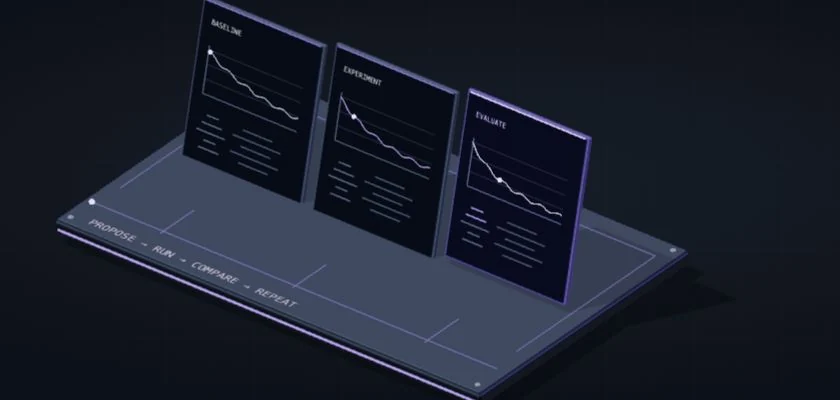
Give an agent a codebase, an objective, an evaluation, and a compute budget. It proposes a change, runs the experiment, and uses the result to decide what to try next.
Inspect the code and previous results. Form a hypothesis and write the change.
Run the modified code in an experiment with a defined time and compute budget.
Measure quality, latency, and compute use against the same baseline and evaluation.
Keep reproducible improvements. Use every result to choose the next experiment.
We’ll publish methods, evaluations, and reproducible results as the program develops.