
What are the best fal.ai alternatives for model inference?
Nodus, Replicate, Modal, Runpod Serverless and Baseten compared with fal.ai: H100 rates, 200 GPU-hours priced, and a break-even rule for self-hosting.
Which fal.ai alternative fits comes down to how you use fal: calling its hosted image, video and audio models, or running your own model on fal Serverless. If you deploy your own open-weight model, Nodus lists the NVIDIA H100 at $2.60/hr on its pricing page, against fal’s $4.50 list price, and Nodus Functions scale to zero between bursts. If you call hosted generative media models by the image or by the second of video, Replicate is the closest swap, and fal is often still the right place to stay.
We build Nodus, so read this with that in mind. Every competitor fact links to that company’s own pricing page or docs, the arithmetic is shown once, and one section covers where fal is the better choice.
What does fal.ai actually sell?
Section titled “What does fal.ai actually sell?”fal sells two different things, and the right alternative differs for each. Its docs describe Model APIs, which run hosted models behind an API key, and fal Serverless, which deploys your own Python apps on fal GPUs.
Model APIs are priced by output. On the fal pricing page, FLUX.1 [schnell] costs $0.003 per megapixel, Nano Banana costs $0.0398 per image, and Kling Video v3 Pro costs $0.14 per second of video. Several of those models are closed, so no other platform can host them for you.
fal Serverless is priced by the GPU-second. The billing docs say runners are billed while alive, including the setup() phase that loads your model and idle time while a runner waits for requests. The same docs say Serverless deploys need access that the fal team approves per account.
Which fal.ai alternatives are worth a look?
Section titled “Which fal.ai alternatives are worth a look?”Five platforms cover most of what fal does, and they split the same way fal does: hosted model APIs on one side, your own container on the other.
| Best for | H100 per hour (listed) | How billing works | Hosted media model APIs | Idle workers | |
|---|---|---|---|---|---|
| fal.ai | Hosted image, video and audio APIs; fal Serverless | $4.50 list, “as low as” $2.49 | Output-based for Model APIs; per second for Serverless | Yes, large catalog | keep_alive default 60 s, billed |
| Nodus | Your own open-weight model as a Function; open LLMs by API (Beta) | $2.60 (H100 SXM) | Prepaid credits; Functions bill while workers run or stay warm | No image or video catalog | scaledown_window default 1 min |
| Replicate | Calling public models; packaging your own with Cog | $5.49 | Per second; public models bill only active time | Yes | Private models also pay setup and idle |
| Modal | Python functions that scale up and down | $3.95 (H100 SXM5) | Per second | No | Scales to zero; scaledown_window sets the idle time |
| Runpod Serverless | Custom inference workers | $5.89 (H100 PRO) | Per second, from worker start to full stop | Public Endpoints for some models | Idle timeout default 5 s |
| Baseten | Dedicated deployments packaged with Truss | $6.50 ($0.10833/min) | Per minute | No | Not stated on the pricing page |
Sources: fal pricing, fal Serverless billing, fal scaling reference, Replicate pricing, Modal pricing, Runpod pricing, Runpod Serverless pricing docs, Runpod Public Endpoints, Modal scaling guide, Replicate billing docs, Baseten pricing, the Nodus pricing page and the Nodus scaling docs. Prices checked November 17, 2026.
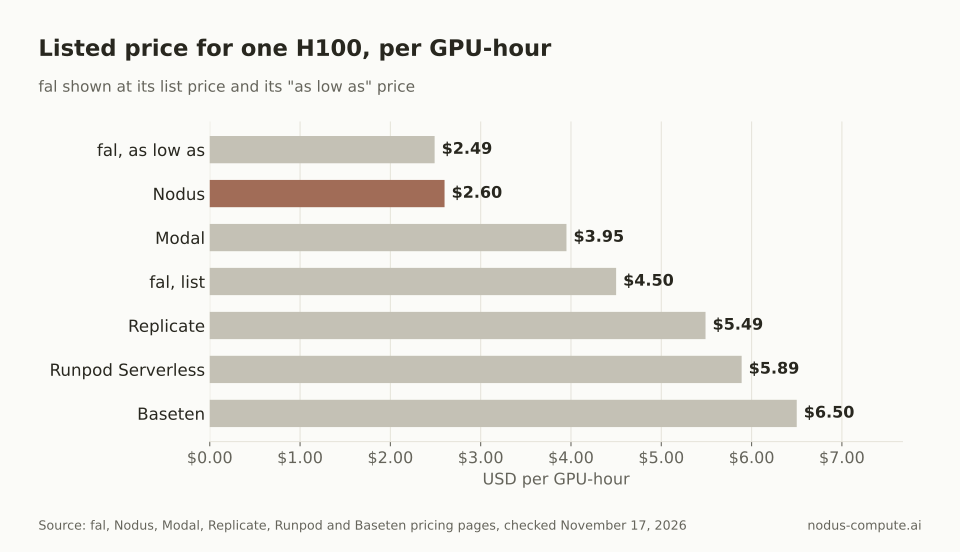 fal’s discounted rate is the only H100 price below Nodus; its list price sits in the middle of the pack.
fal’s pricing page does not say what qualifies a deployment for the “as low as” rate, and it links to sales. We compare against both numbers below so you can see the range.
Which is cheapest for running your own model?
Section titled “Which is cheapest for running your own model?”On listed rates, Nodus is cheapest unless you qualify for fal’s discounted H100 price. We priced one H100 deployment that is alive for 200 hours in a month, which is roughly a busy business-hours service.
| Platform | Rate used | 1 x H100 alive for 200 hours |
|---|---|---|
| fal, “as low as” | $2.49/hr | $498.00 |
| Nodus | $2.60/hr | $520.00 |
| Modal | $0.001097/s | $789.84 |
| fal, list | $4.50/hr | $900.00 |
| Replicate | $0.001525/s | $1,098.00 |
| Runpod Serverless | $5.89/hr | $1,178.00 |
| Baseten | $0.10833/min | $1,299.96 |
The per-second and per-minute rates were multiplied out exactly: 720,000 seconds at $0.001097 is $789.84, 720,000 seconds at $0.001525 is $1,098.00, and 12,000 minutes at $0.10833 is $1,299.96. Against fal’s list price, Nodus is $380.00 less, or 42%. Against fal’s best advertised rate, Nodus is $22.00 more.
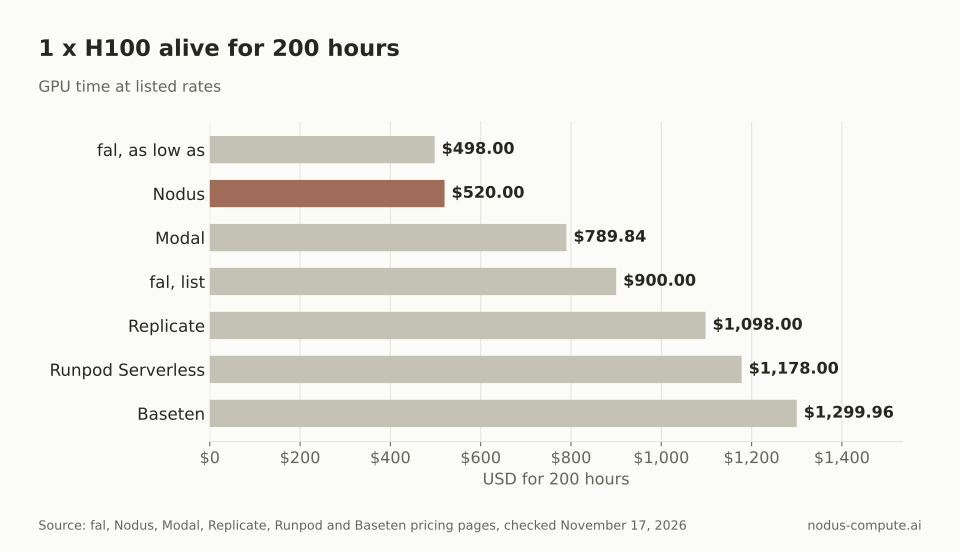 At list prices the same 200 H100-hours cost 42% less on Nodus than on fal.
These rows are GPU time only. Replicate’s H100 includes 13 vCPUs and 144 GB of memory, while the Nodus pricing page lists CPU and memory as separate lines. A preprocessing-heavy service adds to the Nodus figure, so price your real container.
When does self-hosting beat paying per image?
Section titled “When does self-hosting beat paying per image?”Self-hosting wins once one GPU produces more images per hour than its hourly price divided by the per-image price. We worked this rule out from the listed prices below, and it needs only two numbers you can check yourself.
Take FLUX.1 [schnell] at fal’s $0.003 per megapixel. One H100 on Nodus at $2.60/hr breaks even at 2.60 ÷ 0.003 = 867 one-megapixel images per hour, or one image every 4.15 seconds. The same H100 at fal’s $4.50 list price needs 1,500 images per hour to break even. At Modal’s $3.95 per hour it needs 1,316, and at Replicate’s $5.49 it needs 1,830.
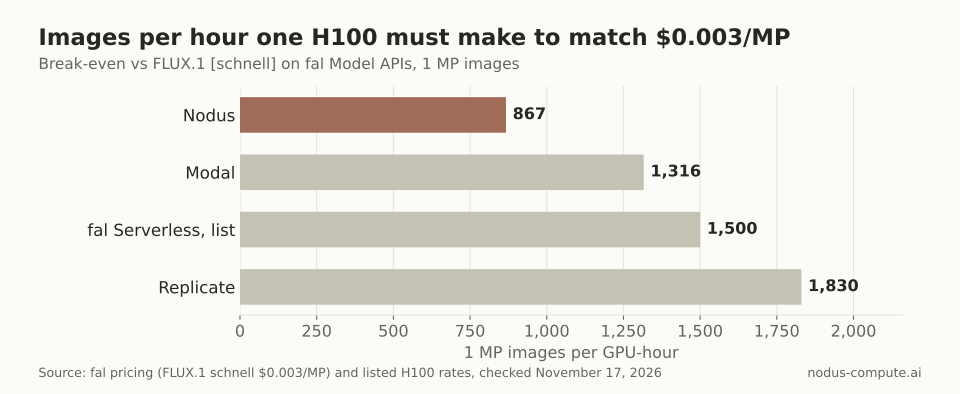 The cheaper the GPU-hour, the lower the throughput you need before your own deployment pays off.
Utilization matters as much as the GPU price. If your traffic keeps the GPU busy only half the hours it is alive, the busy hours must reach 1,733 images each on Nodus.
We have not benchmarked FLUX throughput for this post, so measure your own images per GPU-second before you move. For a cheap model like schnell, staying on the per-image API is often right. For a model with a higher per-output price, the break-even throughput drops in proportion.
Can Nodus serve the models I call on fal?
Section titled “Can Nodus serve the models I call on fal?”Partly. Nodus serves open-weight models through one OpenAI-compatible API, now in Beta, and the docs name GPT-OSS, Whisper and Gemma among eligible models. Closed models are not in the public catalog, and Nodus has no hosted image or video model catalog today.
For image and video work, the Nodus path is your own model as a Function. A GPU class loads weights once in an @nodus.enter() hook and then serves many calls. With GPU snapshots (Beta, enabled per organization), later workers restore the loaded model instead of loading it again. That targets the same cold-start cost fal bills during setup().
Where is fal.ai the better choice?
Section titled “Where is fal.ai the better choice?”fal is the better choice when you want a hosted generative media model with no deployment at all. Its catalog includes closed models like Nano Banana and Kling, which you cannot self-host anywhere. If your volume is low or spiky, paying $0.003 per megapixel beats keeping any GPU warm.
fal also wins on H100 price if your account qualifies for its “as low as” rate of $2.49, which is $0.11 below the Nodus list. And its docs and examples are built around media workloads: ComfyUI workflows, video models and cold-start tuning for large diffusion weights. A team that lives in that world may move faster staying put.
How do you move a fal Serverless app to Nodus?
Section titled “How do you move a fal Serverless app to Nodus?”The concepts map almost one to one. fal’s setup() becomes an @nodus.enter() method, keep_alive becomes scaledown_window, and min_concurrency becomes min_workers. This shape comes from the Nodus GPU snapshot example; swap in your own model loading and handler.
import nodus
app = nodus.App("image-api")image = nodus.Image.debian_slim().pip_install("torch==2.6.0", "transformers==4.53.3")

@app.cls(gpu="A10", image=image, gpu_snapshot=True, scaledown_window="30s")class Generator:    @nodus.enter()    def load(self) -> None:        ...  # load your weights onto the GPU once per cold worker
    @nodus.method()    def generate(self, prompt: str) -> str:        ...  # run one request
Deploy it with nodus deploy app.py, and the App stays up after your program exits. Set the GPU type to the one your model needs from the pricing page. If you also call open LLMs, the Python inference guide shows nodus.llm.openai(), which returns the official OpenAI client pointed at Nodus.
For more options beyond fal, our Replicate alternatives and serverless GPU platforms posts compare the same field from other angles.
Is fal.ai only for image generation?
Section titled “Is fal.ai only for image generation?”No. Its pricing page lists video, audio and 3D models alongside image models, and fal Serverless runs any Python app you deploy. Most of its catalog is generative media rather than text LLMs.
Does fal charge for cold starts?
Section titled “Does fal charge for cold starts?”Partly. fal’s billing docs say scheduling and image pulls are not billed, but the setup() phase that loads your model is, along with idle time. HTTP 500-range errors are not charged.
Can I run LLMs on Nodus instead of a media model?
Section titled “Can I run LLMs on Nodus instead of a media model?”Yes. Nodus inference (Beta) serves open-weight LLMs such as GPT-OSS through an OpenAI-compatible API, and named endpoints add rate limits and a spending cap. Our LLM cost per token guide covers how to compare those prices.
What does an idle worker cost on Nodus?
Section titled “What does an idle worker cost on Nodus?”A warm Nodus Function worker is billed at its rate while it waits, for as long as scaledown_window keeps it, which defaults to one minute. Set min_workers to 0 and the Function scales to zero when nothing is queued.
More from the blog
inference8 min read
How much does LLM inference cost per million tokens?
1M tokens costs $0.09 to $8 of input and $0.18 to $40 of output by tier, but resent context and caching decide most real bills.
Read the postpricing8 min read
What are the best Massed Compute alternatives for AI work?
Massed Compute alternatives for training and inference: H100 prices, billing, recovery and when Nodus, Runpod, Lambda, Modal or Vast.ai fit better.
Read the post